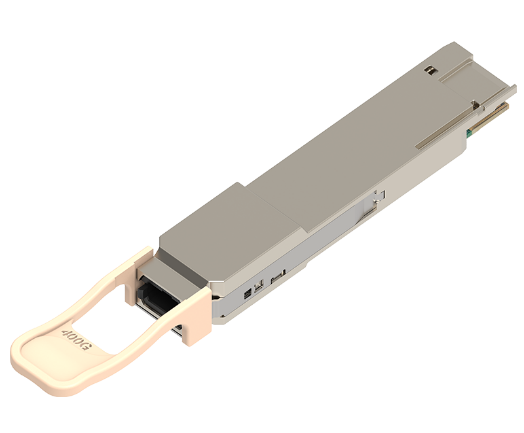



Both DAC and AOC are common cabling solutions for data networking and are usually used for high-speed, high-reliability interconnection and transmission required by data centers, high-performance computers, and large-capacity storage devices. Both of their ends have cable assemblies with factory-terminated transceivers, which are connected to fixed ports only. Besides, DAC and AOC cables can be manufactured in different lengths to support different transmission data rates, such as 10G SFP DAC/AOC cable, 25G AOC cable, 40G DAC cable, and 100G AOC cable.
What is a DAC cable?
A direct-attached cable (DAC) is a copper cable with connectors on both ends. The connectors usually have a latch mechanism or other way of preventing the connections from accidentally pulling loose. A DAC cable is designed to be used inside a rack to interconnect devices that are generally not rack-mounted. These devices include network switches, servers, and storage. DAC cables are called direct-attached because they are designed to be attached directly to the device used to interconnect. They are also called “Twinax” cables because they consist of two twisted pairs of copper wires, commonly called “Twinax” cables.
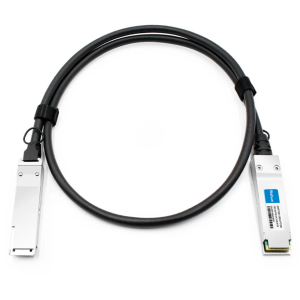
Figure:100G QSFP28 to QSFP28 Copper Direct Attach Cable
What are the DAC cable types?
There are two types of direct attach cables: passive DAC and active DAC. A passive DAC cable is one without signal conditioning to send data. This type of cable is less expensive than an active DAC cable. An active DAC cable contains electric components that amplify the signal. This signal is constantly compared to the data being sent, and any changes are detected and corrected. The active DAC cable is much more expensive, but the improved signal can be helpful for applications such as long distances and high-resolution audio.
Based on the data rate and connector type, the DAC cable is typically available in the following configurations: 10G SFP+ DAC cable, 25G SFP28 DAC cable, 40G QSFP+ DAC cable, 56G QSFP+ DAC cable, 100G QSFP28 DAC cable, 200G QSFP56 DAC cable, 400G QSFP-DD DAC cable, 40G DAC Breakout Cable, 56G DAC Breakout Cable, 100G DAC Breakout Cable, 200G DAC Breakout Cable, 400G DAC Breakout Cable.
What is an AOC cable?
AOC cables are also known as active optical cables. They are multimode fiber optic cables with connectors on both ends and are typically used to connect the network equipment to the network termination device. It has a transmitter and a receiver built inside the cable, which converts electrical signals into light signals and transmits them into fiber optic cables.
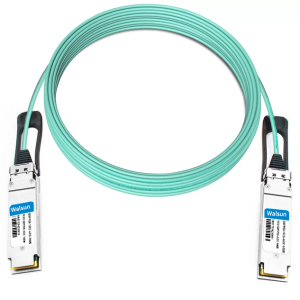
Figuer:100G QSFP28 to QSFP28 Active Optical Cable
What are the AOC cable types?
Based on the data rate and connector type, the AOC cable is typically available in the following configurations: 10G SFP+ AOC cable, 25G SFP28 AOC cable, 40G QSFP+ AOC cable, 56G QSFP+ AOC cable, 100G QSFP28 AOC cable, 200G QSFP56 AOC cable, 400G QSFP-DD AOC cable, 40G AOC Breakout Cables, 56G AOC Breakout Cables, 100G AOC Breakout Cables, 200G AOC Breakout Cables, 400G AOC Breakout Cables.
DAC vs. AOC Cables Comparison, what is the difference?
Choosing a suitable cable is essential to establishing a data center that works well while keeping costs down. While selecting a choice is not always straightforward, taking a few elements into account can completely define what you use and how you use it.
Choosing Between DAC & AOC
Now that we have covered the basic differences between these types of cables, we can discuss use cases. Primarily, there are four categories to consider when choosing between DAC and AOC cables.
Power
Clearly, passive DAC cables use less power than active DAC cables, and it turns out that AOC uses still more power. Passive DAC lines will consume around 0.15W. Active DAC needs around 0.5W, and AOC will run between 1 and 2W. There is more than a 10-fold increase in power consumption between passive DAC and AOC.
Distance
When it comes to performance over distance, AOC is the clear winner. Passive DAC cables are only effective across distances under 7 meters. Active DAC can push that distance up to 15 meters. Meanwhile, AOC lines are effective up to 100 meters, although performance will vary at the extreme ends of this distance.
For any 10G or faster connection beyond 15 meters, AOC is going to be the only viable choice among these three.
Cost
In general, DAC cables cost less to manufacture, and that makes them cheaper. As you would expect, passive DAC is cheaper than active DAC, and AOC is substantially more expensive than active DAC.
Cost savings compound when you optimize your cables. As the cheapest cables are also the shortest, they save money on two fronts. Typically, a network is optimized by minimizing cable length throughout, but in this case, the shortest cables also cost less per meter. When you are able to minimize cable lengths, the savings compound quickly.
Naturally, there are limits to what network design can do for costs. Inevitably, racks will need to communicate, and AOC will prove an affordable option compared to other cables that can run such distances.
EMI
Electromagnetic interference (EMI) is the last major point of comparison. EMI can be a problem in many networks. Since DAC lines use copper, they offer virtually no protection from EMI. Meanwhile, AOC cables are completely shielded and essentially immune to EMI.
When EMI is a point of concern for network design, AOC is the only choice among these three.
High-speed patch cables do a lot of heavy lifting in data centers and high-capacity networks. These three options allow you to fulfill communication needs while optimizing around cost and function. Knowing the advantages of each option can help you with that optimization and lead to the best possible network.
When do you Use DAC Cables?
According to the fabric architecture announced by Facebook, a server and Top-of-Rack switches(ToR) constitute the basic unit of the data center. Generally speaking, the distance between a ToR and a server NIC(Network Interface Card) is less than 5 meters. In this situation, DAC cable is more advantageous than AOC cables in the respect of cost, power consumption, and heat dispersion. Thus, DAC is a preferred option for IDC interconnect systems. Besides, on some special occasions, 100G QSFP28 to 4*SFP28 DAC is an alternative direct connection according to the user’s specific demand for the data connection.
When do you use AOC Cables?
Nevertheless, the transmission distance between ToRs and edge core switches is usually less than 100m, where Integrated circuits are deployed densely. Therefore, the active optical cable is a better cabling solution for data connection due to its merits of lightweight, small wire diameter, and manageable cabling maintenance. Since the data center has strict specifications on signal transmission, active optical cable is better than twin-ax DAC cable in signal integrity and optical coupling design, greatly reducing the errors in signal processing. Furthermore, the high-frequency EMI signal is processed within pluggable optical modules, AOC fiber cable has a better EMI performance than the DAC cable. Undoubtedly, AOC cable is your first option in the interconnection between switches and switches within short or intermediate reach.