


Fiber optic networks are the infrastructure of our modern world, and when fiber optic cables break, society comes to a standstill. Whether it’s a cable or signal problem, it can be frustrating for residents and cable technicians alike. Then OTDR testing finds fiber breaks, faults, and other anomalies that disrupt our connections and our lives. And troubleshoot and detect data network issues affecting every aspect of our daily lives. OTDR testing enables technicians to ensure that fiber optic systems are intact and running smoothly, determine the quality of fibers and their connections, and spot errors or complications that can be addressed. So in this article, let’s see how an OTDR can help with testing and troubleshooting.
Equipment Required to Perform OTDR Testing
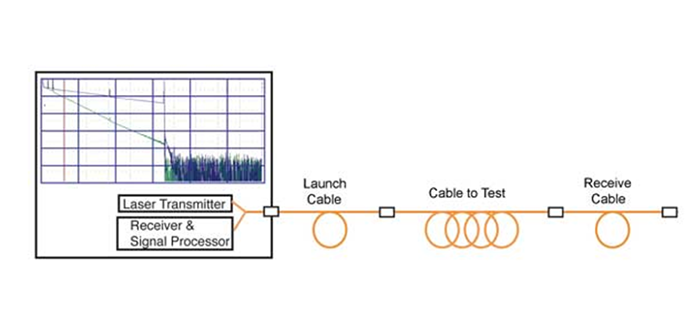
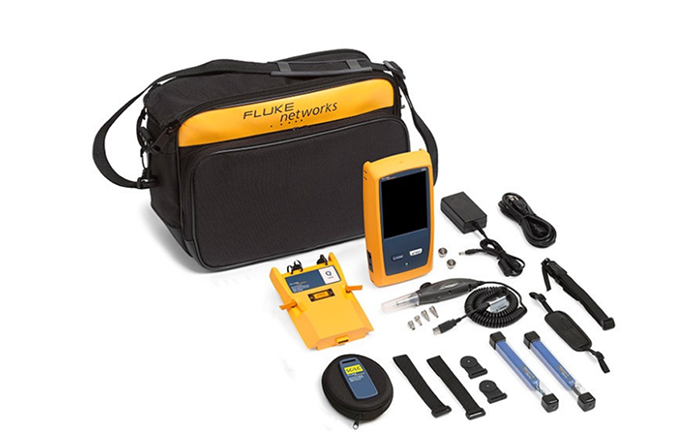
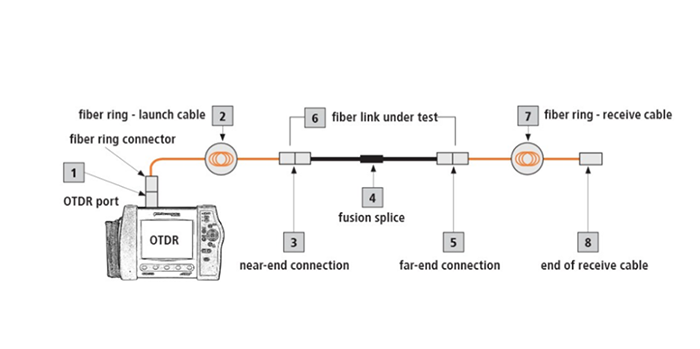
OTDR with modules suitable for cable installations Launch and receive a reference cable with the same fiber type and size as the cable plant and use connectors compatible with the cable plant. Note: If you are testing length, you only need one launch reference cable. Receive cables allow you to measure the loss at the final connector on the cable. b. The reference cable must be long enough for the OTDR’s initial test pulse to stabilize back to the baseline. c. The connectors on the transmit and receive cables must be in good condition (low loss) to properly test the connectors on the cable under test.
How does OTDR Work?
It differs from sources and power meters that directly measure the loss of optical cable equipment. OTDR works indirectly. The source and meter replicate the transmitter and receiver of a fiber optic transmission link, so measurements are closely related to actual system losses.
An OTDR works like radar—it sends pulses down an optical fiber and looks for a return signal, creating displays called “traces” or “signatures” from fiber measurements. It simply connects one end of the fiber, and the OTDR calculates fiber attenuation, uniformity, splice, and connector loss, then provides graphical traceability. Its ability to locate and measure reflectivity and loss makes the OTDR the device for troubleshooting and fault location. It also sends pulses of light energy from a laser diode to one end of the fiber. The photodiode then measures the returning light energy over time and converts it to an electrical value sampled, amplified, and displayed graphically on the screen.
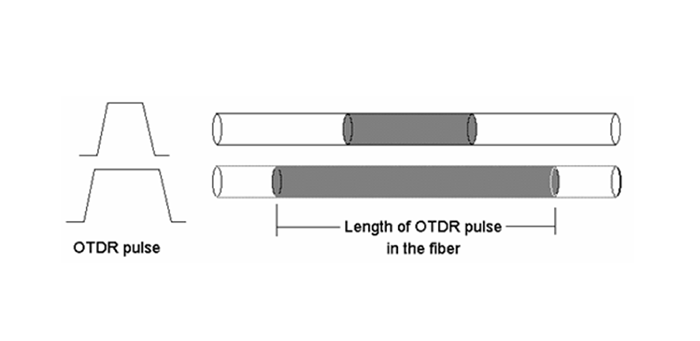
The amount of light scattered back to the OTDR is proportional to the backscattering of the fiber, the peak power of the OTDR test pulse, and the length of the emitted pulse. You can increase the pulse peak power or width if you need more backscattered light to get good measurements.
What Should Be Considered When Choosing OTDR Equipment?
Reliability and Accuracy: High-accuracy loss measurements are critical for fiber optic infrastructure to support critical 5G and IoT services. OTDR is an important investment to ensure the reliability of fiber optic networks. Therefore, the measurements need to be extremely reliable and accurate. In today’s ever-evolving communications environment, you can be confident that top-notch and reliable performance will provide the best return on investment. A low-grade OTDR will result in higher risk and, ultimately, higher cost.
Rugged yet compact form factor: The ODTR was designed with ease of use and ruggedness.
Calibration and service support: Since OTDR equipment needs to be calibrated yearly, choosing domestic companies that provide this service is more economical.
OTDR Parameter Setting: How to Set It Correctly?
To successfully use an OTDR, we need to know how to operate the instrument, select the correct measurement parameters, and interpret the traces correctly. So let’s see how to properly set up the instrument, which is a key factor in making good OTDR measurements.
First, OTDR test range: The first OTDR parameter to set is the range, which is the distance the OTDR will measure. The range should be at least twice the length of the cable we are testing. Longer ranges result in poor resolution traces, while shorter ranges may introduce distortion in the trace.
Second, OTDR Test Pulse Width: Then set the OTDR Test Pulse Width to the shortest pulse width available; this will give the highest resolution and the best “picture” of the fiber under test. This is usually listed in nanoseconds (ns), with a typical choice of 10 to 30 ns.
Then, OTDR measures the pulse width wavelength: typically, 850 nm for multimode fiber optic cable and 1,310 nm for single-mode fiber—shorter wavelengths have more backscatter, making the trace less noisy. After the initial test, you can make measurements at longer wavelengths (multimode 1,300 nm and singlemode 1,550 nm) and compare the traces at the two wavelengths.
Finally, to improve the signal-to-noise ratio of a trace, the OTDR can average multiple measurements, but the more averages, the longer it takes.
OTDR Testing with Transmit and Receive Cables
The launch and receive cables consist of spools of fiber optics with specific distances. They are usually connected to both ends of the fiber under test, in order to better use OTDR to verify the front and remote connectors. The length of the transmit and receive cables depends on the link being tested – typically between 300m and 500m for multimode testing and between 1000m and 2000m for singlemode testing. For very long distances cables up to 4000 meters can be used. The larger the pulse width, the longer the transmit and receive cables. Always take care that the launch and receive cables must be the same type as the fiber being tested.
Test Program
- Turn on the OTDR and allow time for it to warm up.
- Set parameters on the OTDR suitable for the cable equipment under test (range, wavelength, average times, etc.) Clean all connectors and mating adapters.
- Connect the launch reference cable to the OTDR and the cable device under test.
- Connect the optional receive cable to the far end of the cable under test.
- Get tracking and analytics.