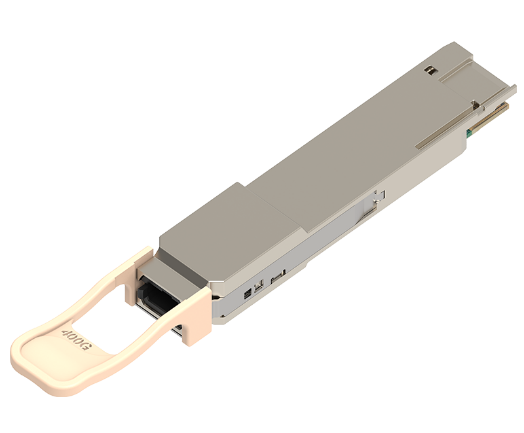



As the smallest size 100G transceiver, the QSFP28 meets the rapidly growing demand of corporate data centers and cloud computing. It has already gradually replaced the 40G QSFP module since it has the same physical size but achieves 2.5-factor traffic throughput. In this article, we will introduce the Walsun 100G QSFP28 transceiver solution and its main features in detail.
QSFP28 Cables Basics
QSFP28 cable contains two forms: one is a form of high-speed cable with QSFP28 connectors on either end, transmitting and receiving 100Gbps data over a thin twinax cable or a fiber optic cable, and the other is a form of breakout cable that can split one 100G signal into 4x 25G (QSFP28 to SFP28) or 2x 50G, enabling connectivity between network devices with different speed ports, while fully utilizing port bandwidth.
| Types | Data Rate | Connector Type | Cable Type |
|---|---|---|---|
| 100G DAC | 100Gbps | QSFP28 to QSFP28 | Passive Twinax Copper Cable |
| 100G DAC Breakout Cables | 100Gbps | QSFP28 to QSFP28 / QSFP28 to SFP28 | Passive Twinax Copper Cable |
| 100G AOC | 100Gbps | QSFP28 to QSFP28 | Optical Cable |
| 100G AOC Breakout Cables | 100Gbps | QSFP28 to QSFP28 | OM3 |
Types of 100G Passive DAC
Generally speaking, there are two kinds of 100G DAC cables: 100G Active DAC and 100G Passive DAC. And 100G Passive DAC is generally divided into three types: 100G QSFP28 to 100G QSFP28 Passive DAC, 100G QSFP28 to 4× 25G SFP28 Passive DAC, and 100G QSFP28 to 2x 50G QSFP28 Passive DAC.
100G QSFP28 to 100G QSFP28 Passive DAC
100G QSFP28 to 100G QSFP28 Passive DAC is a 4-channel parallel passive copper cable that combines four 28 Gbps SFP channels into one high-density cable. It offers 4 independent data transmitting channels and 4 data receiving channels via copper cable, providing a cost-effective way to establish a 100-Gigabit link between QSFP-100G ports of switches within racks and across adjacent racks, ideal for data centers, high-end servers and enterprise wiring closets. QSFP28 DAC is usually applied for Top of Rack (ToR) interconnections between 100G ToR switch and server or the stacking of 100GbE switches (as the figure below).
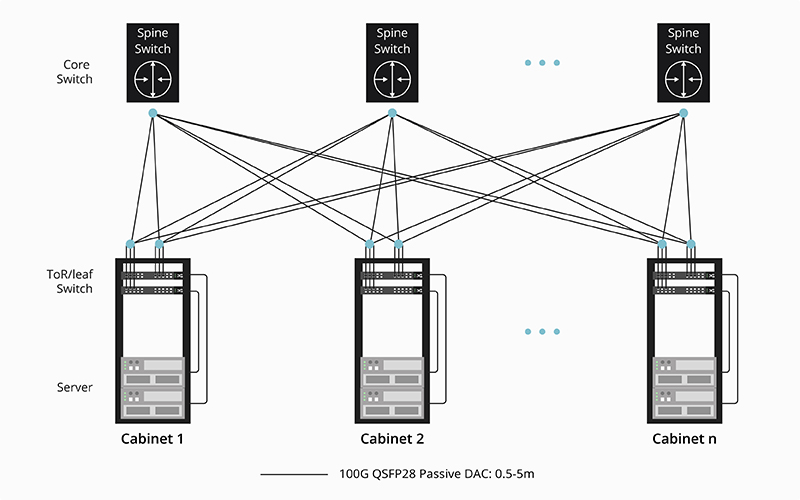
Figure 1: Application of 100G QSFP28 Passive Direct Attach Cable
100G QSFP28 to 4× 25G SFP28 Passive DAC Cable
100G QSFP28 to SFP28 Passive DAC Cable is a breakout cable providing a hybrid transition from a QSFP28 on one end to four individual SFP28 on the other end. It offers four parallel, bi-directional channels each operating at up to 25Gps. Featuring low crosstalk, small bend radius and low power consumption, the 100G to 25G breakout cable meets the ever-increasing demand for higher channel density with high-level signal integrity in high-performance computing, top-of-rack switching, and network storage deployments.
100G QSFP28 to 2x 50G QSFP28 Passive Direct Attach Cable
100G QSFP28 to 2x 50G QSFP28 breakout DAC is a 4-channel parallel copper direct attach cable offering 4 independent data transmission channels and 4 data receiving channels via the cable. The aggregate data rate of 100Gbps over 5m transmission can be achieved with this product. Designed for use in cost-effective 100GbE to 2x 50GbE Ethernet connectivity solution to meet the growing needs for higher bandwidth in data centers, this QSFP28 cable is suitable for the Infiniband EDR and 128G Fiber Channel.

Figure 2: 100G DAC Breakout Cables
Types of 100G AOC
AOC (Active Optical Cable) is a communication cable that needs to use external energy to convert electrical signals into optical signals or conversely in the communication process. There are commonly two types of 100G AOC: 100G QSFP28 to 100G QSFP28 AOC and 100G QSFP28 to 2x 50G QSFP28 AOC.
100G QSFP28 to 100G QSFP28 AOC
100G QSFP28 to 100G QSFP28 AOC cable is composed of multi-mode optical fiber and parallel optical modules. The QSFP28 transceivers at both ends provide photoelectric conversion and optical transmission functions to increase the transmission rate and distance of the optical cable without weakening the compatibility with the standard electrical interface. With no insertion loss and return loss, 100G AOC is mainly used for short-distance multi-channel data communication applications in several locations in the data center like ToR, EoR and MoR (as the figure below).
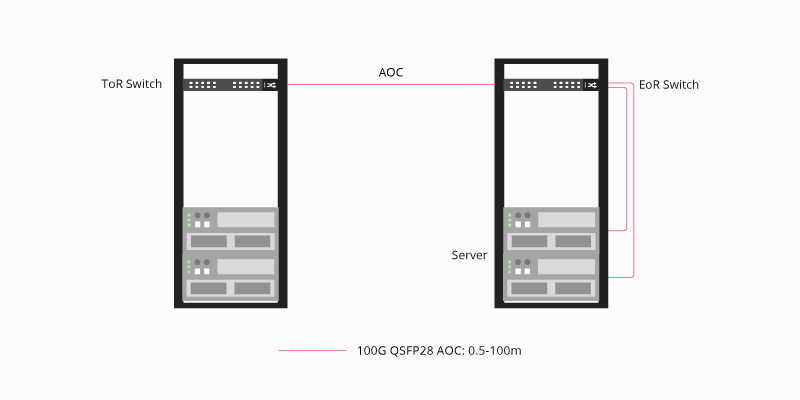
Figure 3: Application of 100G QSFP28 AOC
100G QSFP28 to 2x 50G QSFP28 AOC
100G QSFP28 to 2x 50G QSFP28 breakout AOC is a high data rate parallel AOC, to overcome the bandwidth limitation of traditional copper cable, terminated with a QSFP28 module at one end and two 50G QSFP28 modules at the other. It provides a cost-effective solution for data center interconnecting using devices with 100G QSFP28 ports and 50G QSFP28 ports, which is also ideal for High Performance Computing (HPC) and network storage deployments.
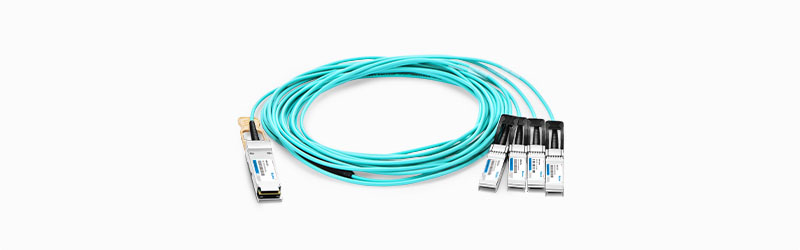
Figure 4: 100G AOC Breakout Cables
FAQs About 100G DAC/AOC Cables
Q1: Can I use QSFP+ optics on QSFP28 ports?
A: Yes, 100G QSFP28 ports can generally take either QSFP+ or QSFP28 optics. QSFP28 transceivers have the same form factor as the QSFP+ optical modules, and a QSFP28 module can break out into either 4x 25G or 4x 10G lanes, which depends on the transceiver used. It means that QSFP+ optics can be used on the QSFP28 ports at a lower 40G speed. However, QSFP28 modules can not be used on QSFP+ ports as the speed of the ports is lower than that of the optics used.
Q2: Can 100G QSFP28 interfaces interoperate with SR10-based 100GbE?
A: No. The QSFP28 form factor has just 4 electrical lanes, which is not enough to support 10 lanes of 10G electrical interface. A QSFP 100G can only support a 4x 10G or 4x 25G electrical interface, which can be used as 4x 10GbE or 4x 25GbE, but not 10x 10GbE. As a result, the 100G QSFP28 interfaces cannot interoperate with SR10-based 100GbE transceivers.
Q3: Can QSFP28 transceiver work with the CFP transceiver?
A: Yes, both are products of the Ethernet protocol and can interoperate with each other.
Q4: How to achieve 100G to 4x 25G breakout application?
A: A simple 100G to 4x 25G breakout connection can be made between one QSFP28 SR4 transceiver and four SFP28 transceivers with breakout cables. In addition to 100G transceivers, breakouts can also be implemented with AOCs or DACs.