



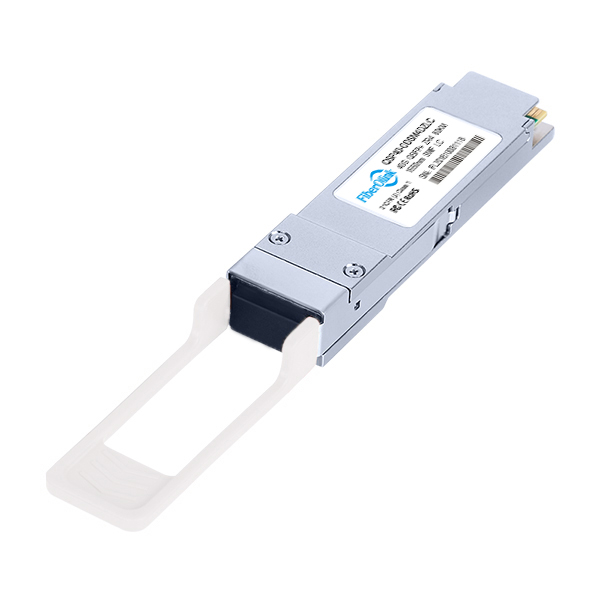
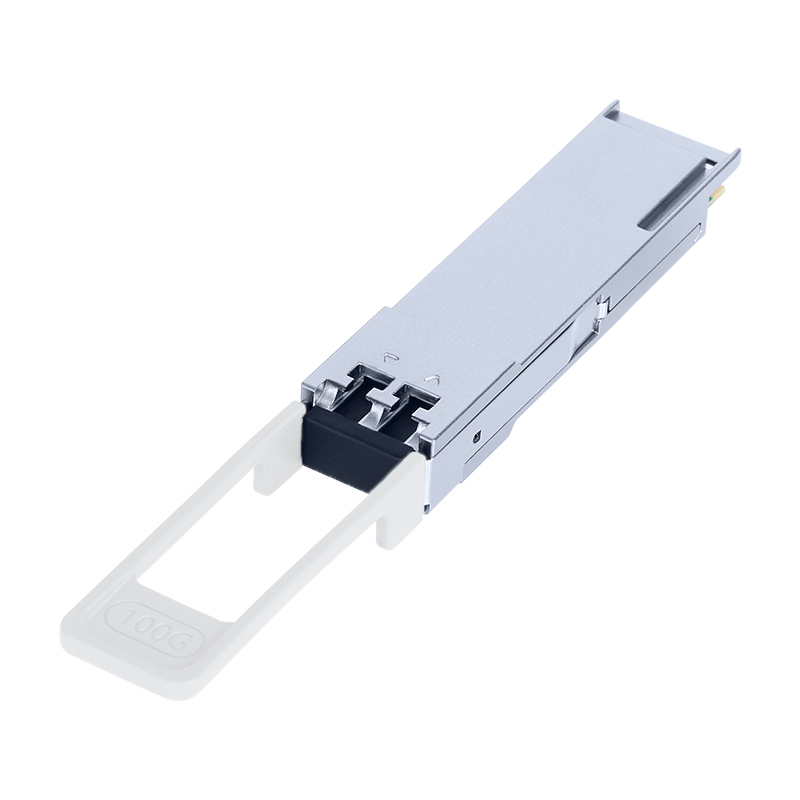
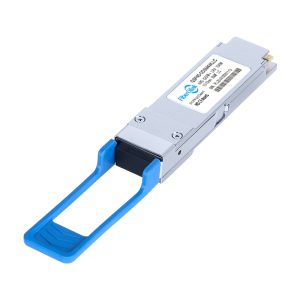
40G QSFP+ ZR4 80km
- Single waelength 40Gbps transmission
- Fixed waelengths on DWDM 100GHz Grid
- Up to 80km oer SMF (with DCM and EDFA)
- Duplex LC connector
- Power dissipation 3.5W (Max)
- 4 x 10G Electrical interface at the host side
- Compliant with QSFP+ MSA SFF-8679
- Compliant with QSFP+ MSA SFF-8636
- QSFP+ MSA digital monitoring functions
- Safety Certification: TUV/UL/FDA*Note1
- RoHS Compliant
Warranty : 30-Day Free Return, 3-Year Free Replacement, 5-Year Warranty, Lifetime After-sales Technical Support.
| Product Model | QSFPP-DW40G22-80C | Vendor Name | Fiberolink |
| Form Factor | QSFP+ | Max Data Rate | 40Gbps |
| Wavelength | 1559.79nm | Max Distance | 80km(with DCM and EDFA) |
| Connector | Duplex LC | Transmitter Type | DWDM EML |
| Cable Type | SMF | Receiver Type | PIN |
| TX Power | 0~+4.0dBm | Receiver Sensitivity | < -11.0dBm |
| Protocols | QSFP+ MSA: SFF-8636,SFF-8679 | Operation Temperature | 0 to 70°C (32 to 158°F) |
Q: Which 40G optical modules can be used for 4x10G transmission?
A: The 40GBASE-SR4, 40GBASE-CSR4, 40GBASE-PLR4, and 40GBASE-PLRL4 optical modules all employ parallel technology with 4 channels in each direction, making them suitable for 4x10G transmission.
Q: What kind of cable should be used with QSFP+ PLR4 and QSFP+ PLRL4 optical modules?
A: They both require the use of single-mode fiber jumpers equipped with MTP-12 APC connectors.
Q: What are the advantages and disadvantages of QSFP+ DAC high-speed cables?
A: QSFP+ DAC high-speed cables boast advantages such as low cost, low power consumption, high interoperability, and plug-and-play functionality; however, they are heavy, bulky,difficult to transport, have limited transmission distance, and can be challenging to manage. QSFP+ AOC high-speed cables, on the other hand, are lighter, offer greater bandwidth, and feature electromagnetic interference resistance, ensuring safer data transmission with higher performance.
Q: How to choose appropriate QSFP+ DAC high-speed cables and QSFP+ AOC high-speed cables?
A: When the transmission distance is less than 15 meters, QSFP+ DAC high-speed cables provide the most cost-effective solution. For distances between 15 meters and 100 meters, it’s advisable to use 40G QSFP+ AOC high-speed cables. Beyond 100 meters, 40G SR4 optical modules can be paired with OM3 or OM4 multimode fiber jumpers, or 40GBASE LR4 optical modules can be used with single-mode fiber jumpers to achieve even longer transmission distances.
Q: What are the typical solutions for a 40G network?
A: At the core of the 40G network layer, a common setup involves using multimode fibers like OM3 or OM4 connected at both ends by pairs of optical modules (most commonly 40G QSFP+ optical modules), primarily for long-distance transmissions; high-speed cables and active optical cables often serve as cost-saving alternatives to these optical modules and fibers in short-range interconnect applications.
Q: Power consumption of 40G QSFP+ optical modules
A: Power consumption varies by module, typically ranging around 1-3 watts, optimized for energy efficiency to meet the requirements of data centers.
Q: Compatibility of 40G QSFP+ optical modules
A: Compatibility is generally good, adhering to the MSA (Multi-Source Agreement) to ensure interoperability among different vendors, though it’s recommended to check the compatibility list for confirmation.
Q: Form factor of 40G QSFP+ optical modules
A: The form factor measures approximately 7×2.35×0.35×0.85 inches (length x width x height), featuring a compact design suitable for high-density line card slots.
Q: Bit error rate of 40G QSFP+ optical modules
A: The bit error rate is exceedingly low, typically <10^-12, ensuring accuracy in data transmission and network reliability.
Related products
-
 Optical Transceivers
40G QSFP+ BIDI ZR4 80km
-
 40G QSFP+
40G QSFP+ SR4 850nm 100m
-
 Optical Transceivers
40G QSFP+ ER4 40km
-
 Optical Transceivers
40G QSFP+ LR4 10km