



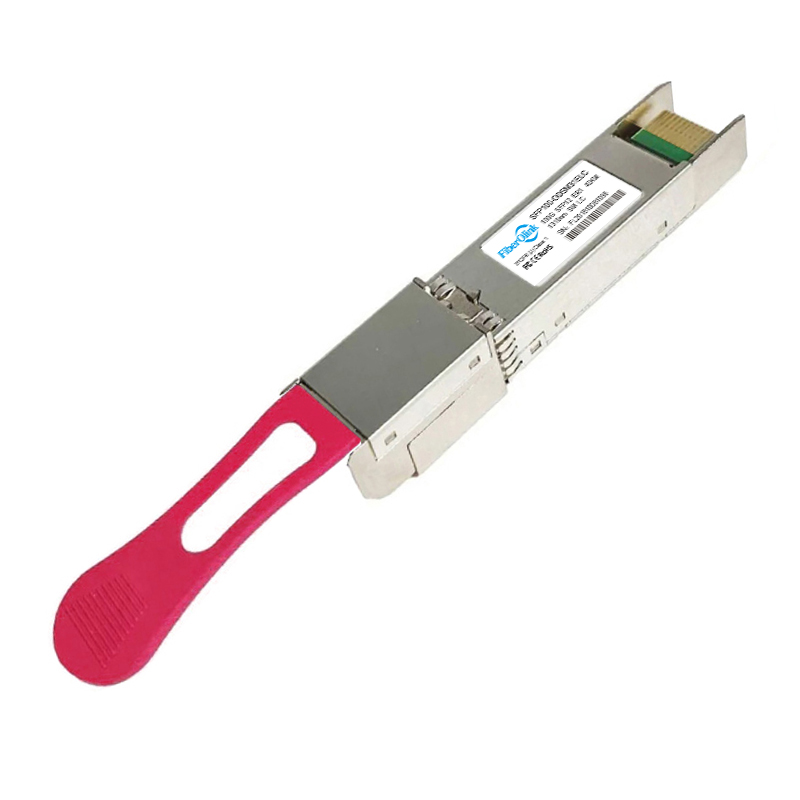
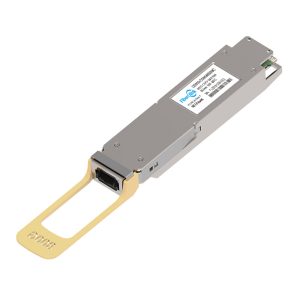
112G QSFP28 ER4 40km
- Using hot-pluggable QSFP28 package
- Full-duplex integrated transceiver module
- DML transmitter and APD receiver
- Compliant with IEEE 802.3bm, SFF-8636, and QSFP28 MSA Ethernet standards
- Maximum power consumption less than 4.5W
- Built-in Digital Diagnostics Monitoring (DDM)
- Power supply voltage 3.3V
- Compliant with RoHS environmental standards (lead-free)
- Class 1/1M compliant product, meets IEC60825-1 requirements
- Meets Telcordia (Bellcore) GR-468-CORE reliability requirements
- Meets EMI and ESD requirements
Warranty : 30-Day Free Return, 3-Year Free Replacement, 5-Year Warranty, Lifetime After-sales Technical Support.
| Product Model | QSFP-112G-ER4 | Vendor Name | Fiberolink |
| Form Factor | QSFP28 | Data Rate | 103.125Gbps |
| Wavelength | 1310nm | Distance | 30km(no FEC) |
| Connector | LC Duplex | Cable Type | SMF |
| Transmitter Type | DML | Detector Types | APD |
| TX Power | -2.5~2.9dBm(100G) -1~3.3dBm(112G) | Receiver Sensitivity | <-15dBm(100G) / < -19dBm(112G) |
| Power Consumption | ≤4.5W | Operation Temperature | 0~70°C |
| DDM | Support | EMC | Support |
| Modulation | NRZ | CDR | TX & RX with built-in CDR |
| Protocols | IEEE 802.3ba, SFF-8636, QSFP28 MSA, OTN OTU4 | ||
Q: How many types of 100G QSFP28 optical modules are there?
A: Currently, there are several types of 100G optical modules in the market. These include 100G QSFP28 SR4, 100G QSFP28 PSM4, 100G QSFP28 CWDM4, 100G QSFP28 LR4, 100G QSFP28 ER4, and 100G QSFP28 ZR4. For detailed parameters, please refer to the table below.
|
Product Type
|
Max Transmission Distance
|
Wavelength
|
Interface Type
|
Fiber Type
|
|---|---|---|---|---|
|
150m
|
850nm
|
Multimode
|
MPO
|
|
|
10km
|
LWDM4
|
Singlemode
|
LC
|
|
|
40km
|
LWDM4
|
Singlemode
|
LC
|
|
|
80km
|
LWDM4
|
Singlemode
|
LC
|
|
|
80km
|
1310nm
|
Singlemode
|
LC
|
|
|
40km
|
1310nm
|
Singlemode
|
MPO
|
Q: How to choose and use 100G QSFP28 optical modules?
A: For switch multimode fiber wiring of 5-100 meters: Use the 100G QSFP28 SR4 optical module. For distances less than 70 meters, use OM3 multimode fiber; for distances between 70 to 100 meters, use OM4 multimode fiber. The 100G QSFP28 SR4 is suitable for 100G network transmissions across different floors.
For switch-to-switch single-mode fiber wiring of 100 meters to 2 kilometers: Use either the 100G QSFP28 CWDM4 or 100G QSFP28 PSM4 optical modules, both with a maximum transmission distance of 2 kilometers. The module costs are comparable, but the MPO cable cost for connecting PSM4 is higher than the LC cable cost for connecting CWDM4. This setup is suitable for 100G network transmissions between different buildings.
For building interconnections of 2 kilometers to 10 kilometers: Use the 100G QSFP28 LR4 optical module with a maximum transmission distance of 10 kilometers, utilizing single-mode fiber. It is suitable for 100G network transmissions within the same city or administrative region.
For long-distance transmissions within data centers of 10 kilometers to 40 kilometers: Use the 100G QSFP28 ER4 optical module with a maximum transmission distance of 40 kilometers, utilizing single-mode fiber. It is suitable for 100G network transmissions between different administrative regions within the same city.
In practical applications, factors such as cost, power consumption, transmission distance, and types of jumpers are considered. The choice of application depends on the transmission distance of different optical modules, the type of fiber used, power consumption, wavelength, and other factors.
Q: Are QSFP28 and QSFP+ optical modules compatible?
A: QSFP28 optical modules cannot be used in QSFP+ ports. Similarly, SFP+ optical modules cannot operate in SFP ports, and QSFP28 optical modules cannot be used in QSFP+ ports. When mixing optical modules of different rates in switches, compatibility depends on the type of fiber used and the port shape of the switch. The module’s port must match the switch port, and the switch port speed must equal or exceed the optical module’s speed to ensure normal network transmission. QSFP28 ports can use QSFP+ optical modules, but QSFP28 optical modules cannot achieve 100Gbps data transmission in QSFP+ ports.
Q: Is it necessary to clean the connectors of QSFP28 SR4 optical modules? If yes, how should it be cleaned?
A: Yes, dust and contaminants can accumulate on the connectors of QSFP28 SR4 optical modules, potentially reducing the transmitted optical power and affecting transmission stability. To ensure stable transmission, Huanxin Optics recommends cleaning the connectors each time they are disconnected and reconnected. A one-click MTP/MPO fiber optic cleaning pen is the best choice for cleaning QSFP28 SR4 optical modules.
Related products
-
 100G QSFP28 Duplex
100G QSFP28 PAM4 ER1 1310nm 40km
-
 100G QSFP28 BiDi
100G QSFP28 10km BIDI
-
 400G QSFP-DD
400G QSFP-DD ER4 30km
-
 800G QSFP-DD
800 QSFP-DD SR8 850nm 100m