



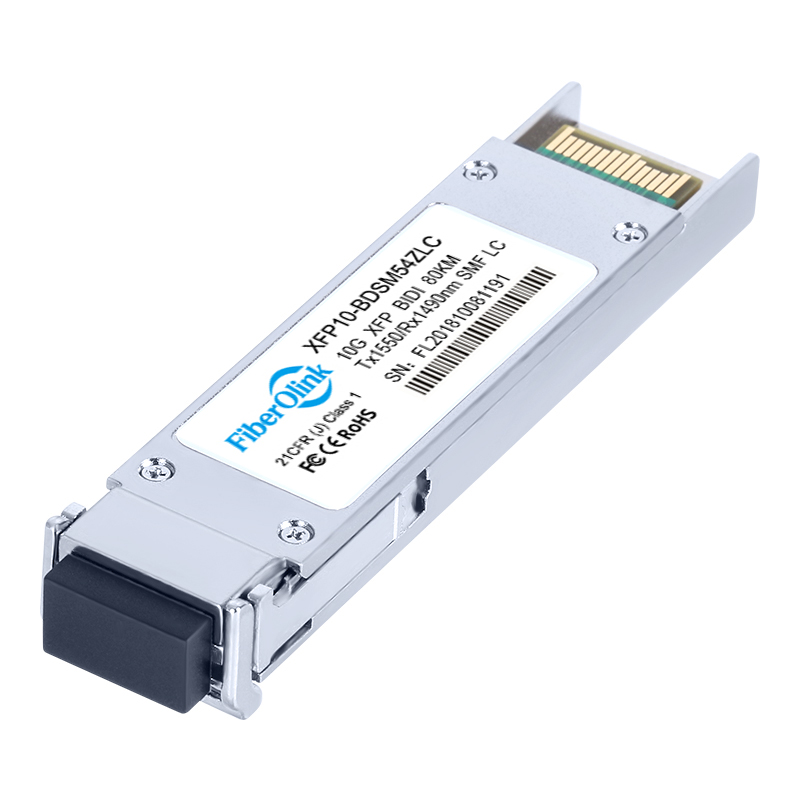
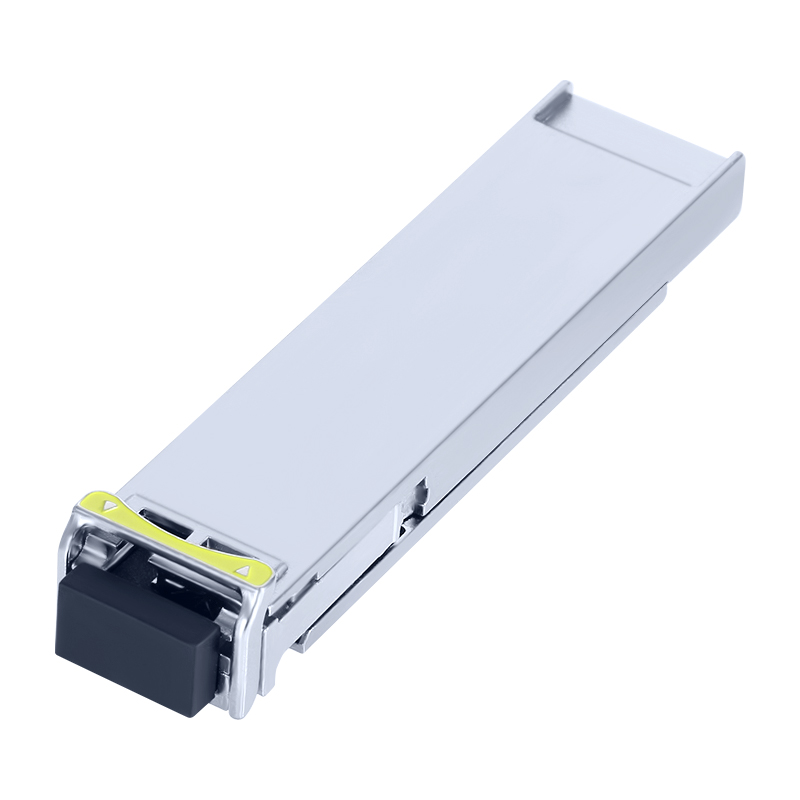
10G BIDI XFP ZR 1550Tx 1490Rx 80km
• Hot-pluggable XFP footprint
• Supports 9.95Gbps to 11.1Gbps bit rates
• Compliant with IEEE 802.3ae
• 1550nm EML transmitter, 1490nm APD receiver
• Distance up to 80km on single mode fiber
• Single LC connector
• Built-in digital diagnostic functions
• Single 3.3V power supply
• No Reference Clock required
• Very low EMI and excellent ESD protection
• ROHS compliant and lead-free
Warranty : 30-Day Free Return, 3-Year Free Replacement, 5-Year Warranty, Lifetime After-sales Technical Support.
| Model Name | BIDI-XFP-80 | Vendor Name | Fiberolink |
| Form Factor | XFP BIDI | Max Data Rate | 10.3125Gbps |
| Wavelength | 1550nm-TX/1490nm-RX | Fiber Type | SMF |
| Connector | LC Simplex | Optical Components | EML/APD |
| Max Distance | 80km | Extinction ratio | > 7.5 dB |
| Transmitter Power | -1 ~ 4 dBm | Receiver Overload | > -7 dBm |
| Receiver Sensitivity | < -23 dBm | Digital Diagnostic Monitoring | Yes |
| Environment | Operating: 0°C to 70°C Storage: -40°C to 85°C | Weight | 0.05 kg |
| Application | 10GBASE-ZR/10GBASE-ZW Ethernet 10G Fiber Channel 10G Data Center Switches and Routers 10G Network interface cards and Fiber Media Converters | Compliance | IEC/EN 61000-4-2, IEC-60825 FDA 21CFR 1040.10 and 1040.11 RoHS |
Q: How soon can you ship my order after I place it?
A: Following the approval of your order, the product will require 1-3 working days for production and inventory preparation. It will then be shipped directly from our warehouse to you, and you will receive a notification SMS from our company.
Q: What are the differences between XFP and SFP+ optical modules?
A: (1) They differ in appearance, and SFP+ modules are smaller in size compared to XFP modules;
(2) There are functional disparities, with XFP modules featuring signal modulation, serialization/deserialization, MAC, clock and data recovery (CDR), and electronic dispersion compensation (EDC) functions, which are not typically present in SFP+ modules. Thus, XFP modules are required to fill the gap when these functionalities are not integrated into the switch/router’s motherboard.
(3) They adhere to different protocols: XFP modules follow the XFP MSA Agreement, whereas SFP+ modules comply with IEEE 802.3ae, SFF-8431, and SFF-8432 standards.
Q: Can XFP and SFP+ optical modules be interconnected?
A: Provided that the transmission rate, transmission distance, and wavelength are identical, they can indeed be interconnected using optical fibers. For instance, a 10G XFP optical module with a wavelength of 1310nm and a transmission distance of 10KM can be interconnected with a 10G SFP+ optical module of the same wavelength and distance. Despite the market seeing optical modules with transmission speeds reaching 200G, this doesn’t signify the obsolescence of 10G modules; currently, 10G modules remain the mainstream choice. Due to differences in size, structure, and compatibility, 10G XFP and 10G SFP+ optical modules cannot substitute for one another.
Related products
-
 Optical Transceivers
10G BIDI SFP+ ZR+ 1550Tx 1490Rx 100km
-
 Optical Transceivers
10G DWDM SFP+ CH17-CH61 100km
-
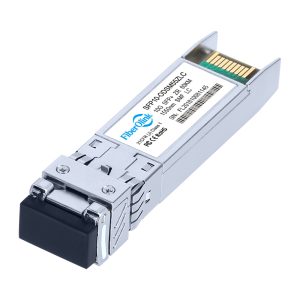 Optical Transceivers
10G SFP+ ZR 1550nm 80km
-
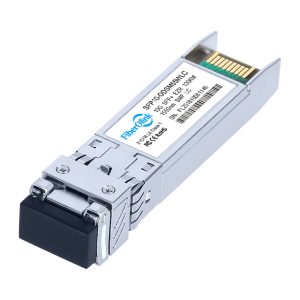 Optical Transceivers
10G SFP+ 1550nm 100km