



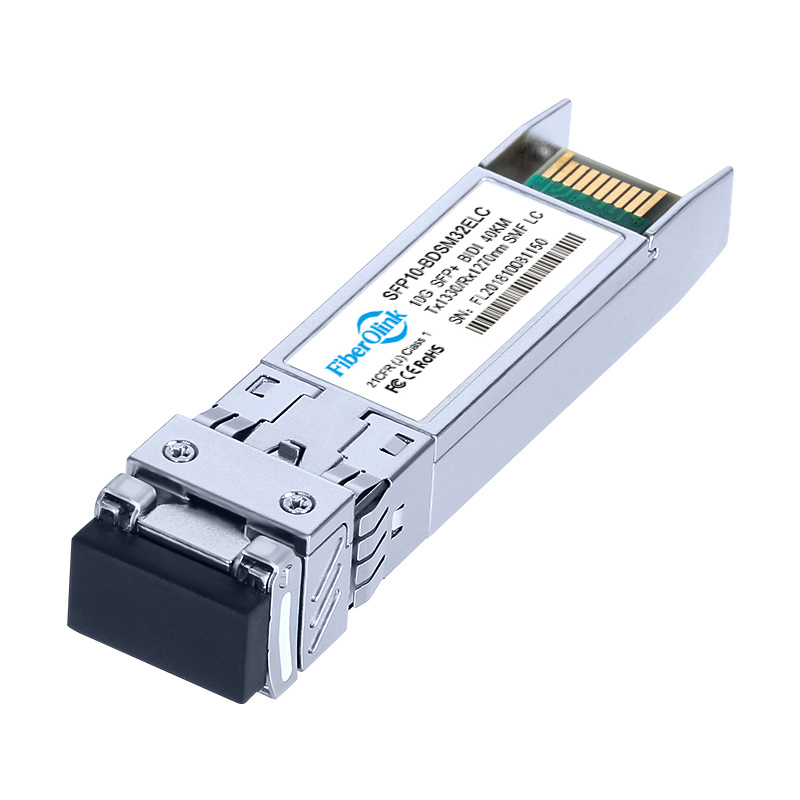
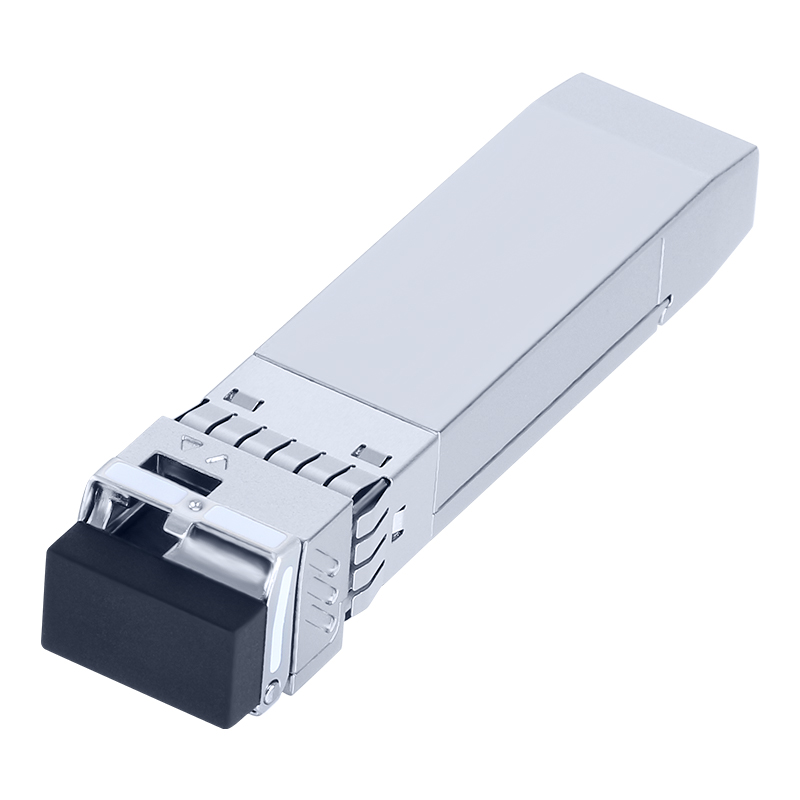
10G BIDI SFP+ ER 1330Tx 1270Rx 40km
- Utilizes hot-swappable SFP+ package simplex transceiver module
- 1330nm DFB transmitter and PIN receiver
- Compliant with IEEE 802.3z, SFF-8472, and SFP+ MSA Ethernet standards
- Maximum power consumption less than 1.5W
- Built-in Digital Diagnostic Monitoring (DDM)
- Power supply voltage 3.3V
- Compliant with RoHS environmental standards (lead-free)
- Class 1/1M specification products, compliant with IEC60825-1 requirements
- Meets Telcordia (Bellcore) GR-468-CORE reliability requirements
- Meets EMI and ESD requirements
Warranty : 30-Day Free Return, 3-Year Free Replacement, 5-Year Warranty, Lifetime After-sales Technical Support.
| Product Model | SFP-10G-BIDI-40 | Vendor Name | Fiberolink |
| Form Factor | SFP+ | Data Rate | 10.3125Gbps |
| Wavelength | TX-1330nm/RX-1270nm | Distance | 40km |
| Connector | LC Simplex | Cable Type | SMF |
| Transmitter Type | DFB | Detector Types | PIN |
| TX Power | 0~5dBm | Receiver Sensitivity | < -15dBm |
| Power Consumption | ≤1.5W | Operation Temperature | 0~70°C |
| DDM | Support | EMC | Support |
| Protocols | IEEE 802.3z, SFF-8472, SFP+ MSA, CPRI, eCPRI | ||
Q、Comparison: SFP-10G-SR vs SFP-10G-LR vs SFP-10G-LRM
A、Let’s compare their differences and similarities, which will assist you in selecting the appropriate 10G SFP+ module based on your specific application needs.
| SFP-10G-SR | SFP-10G-LR | SFP-10G-LRM | |
|---|---|---|---|
| Package Type | SFP+ | SFP+ | SFP+ |
| Rate | 10 Gbps | 10 Gbps | 10 Gbps |
| Wavelength | 850nm | 1310nm | 1310nm |
| Max. Distance | 300m/400m | 10km | 220m/300m |
| Interface | LC duplex | LC duplex | LC duplex |
| Laser Type | VCSEL 850nm | DFB 1310nm | FP 1310nm |
| Fiber Optic Type | MMF | SMF | SMF/MMF |
| DOM | YES | YES | YES |
| Transmitted Light Power | -7.3~-1dBm | -8.2~0.5dBm | -6.5~-0.5dBm |
| Received Sensibility | < -11.1dBm | < -14.4dBm | < -8.4dBm |
| Commercial Temperature | 0~ 70°C (32 ~ 158°F) | 0~ 70°C (32 ~ 158°F) | 0~ 70°C (32 ~ 158°F) |
| Application Range | Only used for short distance connections | Only used for long distance connections | Only used for short distance connections |
Q、What precautions should be taken when connecting 10G SFP+ optical modules to switches?
A、1. Ensure that the wavelengths, transmission distances, and fiber types (single or multi-mode, single or dual fiber) of the optical modules used at both ends of the switches match. If there is inequality, use the corresponding converter to address the disparity.
Minimize exposure to static electricity and physical impacts during use. In case of accidental bumps, it is not advisable to continue using the optical module.
Pay attention to the orientation when inserting the optical module, ensuring that the pull tab and label face upwards.
While inserting the module into the switch, exert sufficient force to push it all the way in until you feel a slight click. Afterwards, gently tug on the module to verify that it is securely installed.
When removing the optical module, first, pivot the latching handle to a 90-degree angle relative to the optical port before carefully extracting the module.
Related products
-
 Optical Transceivers
10G SFP+ ZR++ 1550nm 120km
-
 Optical Transceivers
10G DWDM SFP+ ER CH17-CH61 40km
-
 Optical Transceivers
10G CWDM SFP+ ER 40km
-
 Optical Transceivers
10G SFP +LR 1310nm 10km