



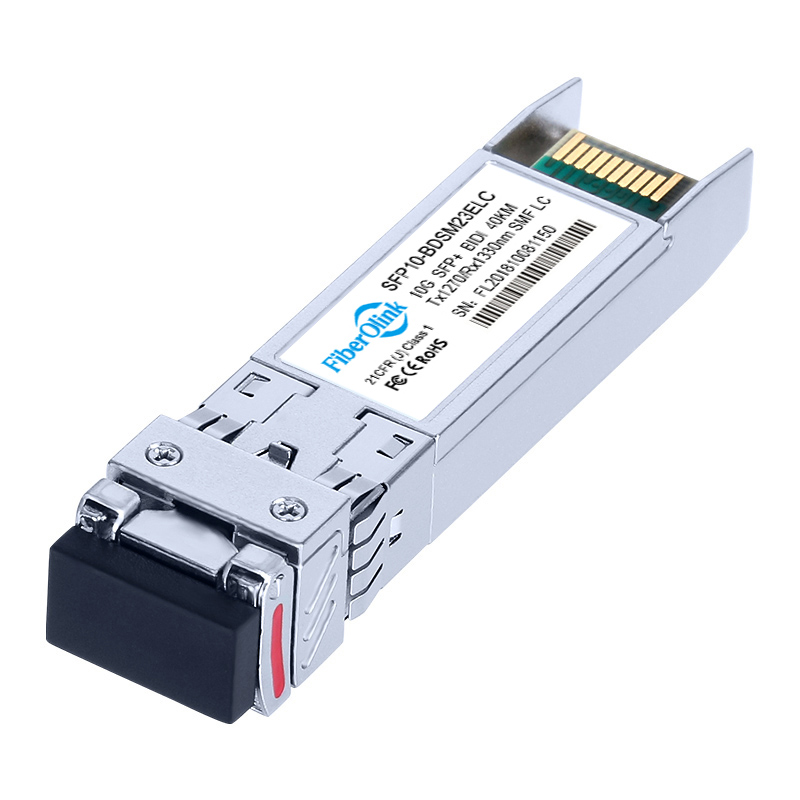
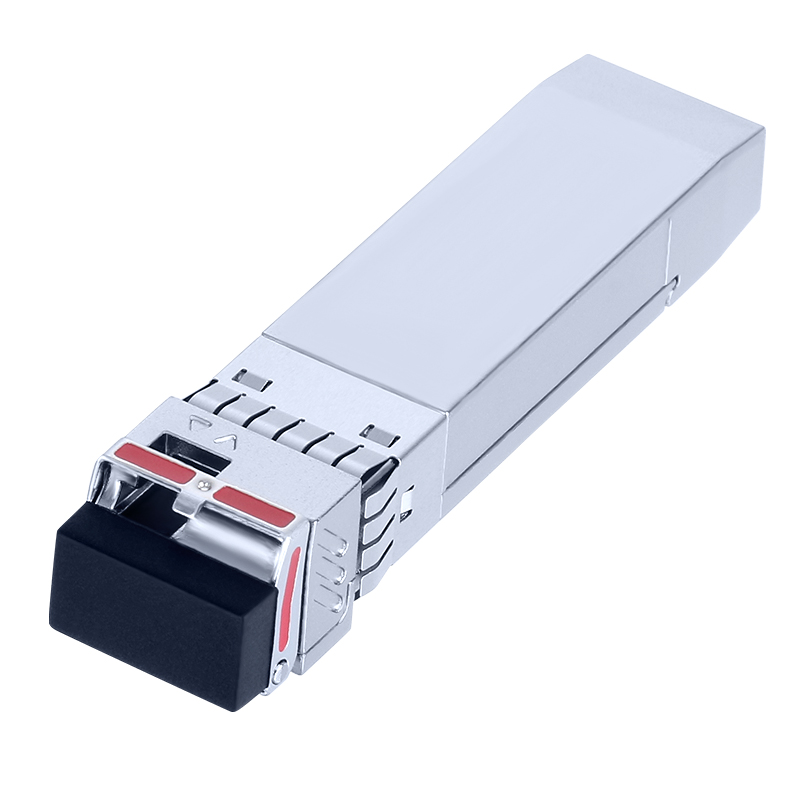
10G BIDI SFP+ ER 1270Tx 1330Rx 40km
- Utilizes hot-swappable SFP+ package simplex transceiver module
- 1270nm DFB transmitter and PIN receiver
- Compliant with IEEE 802.3z, SFF-8472, and SFP+ MSA Ethernet standards
- Maximum power consumption less than 1.5W
- Built-in Digital Diagnostic Monitoring (DDM)
- Power supply voltage 3.3V
- Compliant with RoHS environmental standards (lead-free)
- Class 1/1M specification products, compliant with IEC60825-1 requirements
- Meets Telcordia (Bellcore) GR-468-CORE reliability requirements
- Meets EMI and ESD requirements
Warranty : 30-Day Free Return, 3-Year Free Replacement, 5-Year Warranty, Lifetime After-sales Technical Support.
| Product Model | SFP-10G-BIDI-40 | Vendor Name | Fiberolink |
| Form Factor | SFP+ | Data Rate | 10.3125Gbps |
| Wavelength | TX-1270nm/RX-1330nm | Distance | 40km |
| Connector | LC Simplex | Cable Type | SMF |
| Transmitter Type | DFB | Detector Types | PIN |
| TX Power | 0~5dBm | Receiver Sensitivity | < -15dBm |
| Power Consumption | ≤1.5W | Operation Temperature | 0~70°C |
| DDM | Support | EMC | Support |
| Protocols | IEEE 802.3z, SFF-8472, SFP+ MSA, CPRI, eCPRI | ||
Q、Comparison: SFP-10G-SR vs SFP-10G-LR vs SFP-10G-LRM
A、Let’s examine the similarities and differences among these modules, which will guide you in selecting the appropriate 10G SFP+ module tailored to your specific application needs.
| SFP-10G-SR | SFP-10G-LR | SFP-10G-LRM | |
|---|---|---|---|
| Package Type | SFP+ | SFP+ | SFP+ |
| Rate | 10 Gbps | 10 Gbps | 10 Gbps |
| Wavelength | 850nm | 1310nm | 1310nm |
| Max. Distance | 300m/400m | 10km | 220m/300m |
| Interface | LC duplex | LC duplex | LC duplex |
| Laser Type | VCSEL 850nm | DFB 1310nm | FP 1310nm |
| Fiber Optic Type | MMF | SMF | SMF/MMF |
| DOM | YES | YES | YES |
| Transmitted Light Power | -7.3~-1dBm | -8.2~0.5dBm | -6.5~-0.5dBm |
| Received Sensibility | < -11.1dBm | < -14.4dBm | < -8.4dBm |
| Commercial Temperature | 0~ 70°C (32 ~ 158°F) | 0~ 70°C (32 ~ 158°F) | 0~ 70°C (32 ~ 158°F) |
| Application Range | Only used for short distance connections | Only used for long distance connections | Only used for short distance connections |
Q、Differences and Connections between SFP+ and SFP
A、(1) Differences:
Protocol Standards: SFP adheres to IEEE802.3 and SFF-8472 standards; whereas, SFP+ complies with IEEE 802.3ae, SFF-8431, and SFF-8432 standards.
Design Dominance: SFP+ represents a more prevalent and advanced design in the industry.
(2) Connections:
Physical Form Factor: SFP and SFP+ share identical dimensions and physical appearance.
Interoperability: Both SFP+ and XFP are 10 Gigabit optical modules, and they are interoperable with other types, highlighting their versatility in high-speed network connectivity solutions.
Related products
-
 Optical Transceivers
10G DWDM XFP ER CH17~CH61 40km
-
 Optical Transceivers
10G BIDI SFP+ ZR+ 1550Tx 1490Rx 100km
-
 Optical Transceivers
10G BIDI SFP+ ER 1330Tx 1270Rx 40km
-
 Optical Transceivers
10G SFP+ ER 1550nm 40km