



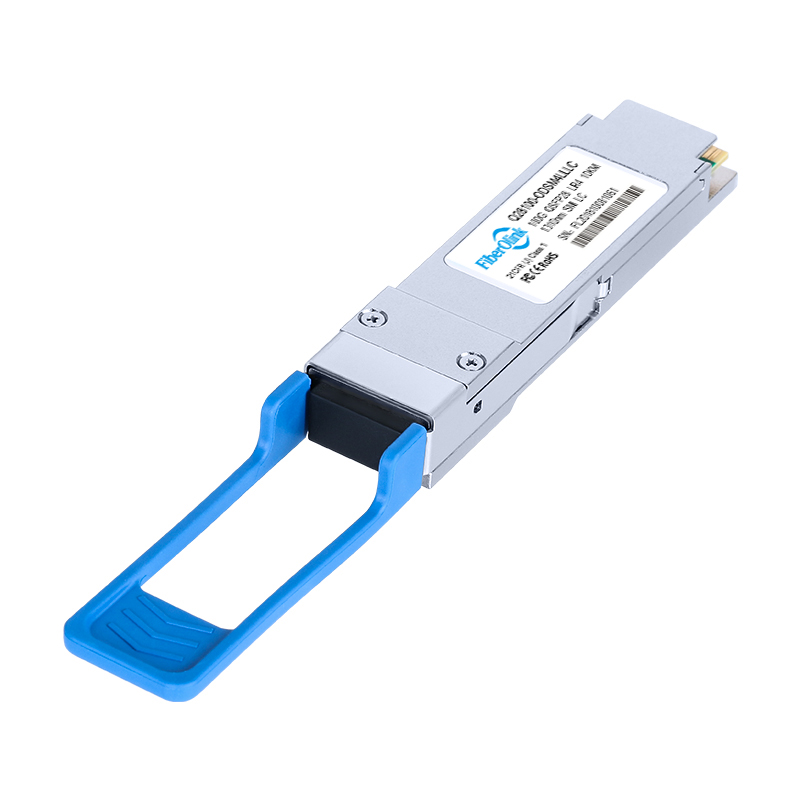
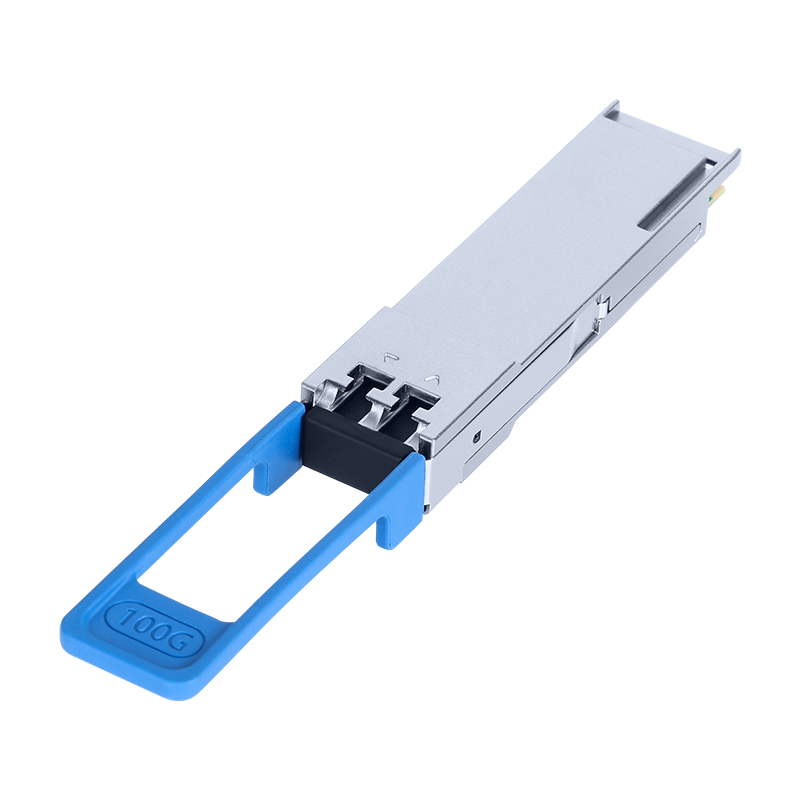
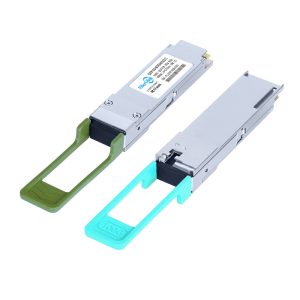
100G QSFP28 LR4 10km
- Using hot-pluggable QSFP28 package
- Full-duplex integrated transceiver module
- EML transmitter and PIN receiver
- Compliant with IEEE 802.3bm, SFF-8636, and QSFP28 MSA Ethernet standards
- Maximum power consumption less than 4.5W
- Built-in Digital Diagnostics Monitoring (DDM)
- Power supply voltage 3.3V
- Compliant with RoHS environmental standards (lead-free)
- Class 1/1M compliant product, meets IEC60825-1 requirements
- Meets Telcordia (Bellcore) GR-468-CORE reliability requirements
- Meets EMI and ESD requirements
Warranty : 30-Day Free Return, 3-Year Free Replacement, 5-Year Warranty, Lifetime After-sales Technical Support.
| Product Model | QSFP-100G-LR | Vendor Name | Fiberolink |
| Form Factor | QSFP28 | Data Rate | 103.125Gbps |
| Wavelength | 1310nm | Distance | 10km |
| Connector | LC Duplex | Cable Type | SMF |
| Transmitter Type | EML | Detector Types | PIN |
| TX Power | -1.4~4.5dBm | Receiver Sensitivity | < -7.7dBm |
| Power Consumption | ≤4.5W | Operation Temperature | 0~70°C |
| DDM | Support | EMC | Support |
| Modulation | PAM4 | CDR | TX & RX with built-in CDR |
| Protocols | IEEE 802.3bm, SFF-8636, QSFP28 MSA | ||
Q: How many types of 100G QSFP28 optical modules are there?
A: Currently, there are several types of 100G optical modules in the market. These include 100G QSFP28 SR4, 100G QSFP28 PSM4, 100G QSFP28 CWDM4, 100G QSFP28 LR4, 100G QSFP28 ER4, and 100G QSFP28 ZR4. For detailed parameters, please refer to the table below.
|
Product Type
|
Max Transmission Distance
|
Wavelength
|
Interface Type
|
Fiber Type
|
|---|---|---|---|---|
|
150m
|
850nm
|
Multimode
|
MPO
|
|
|
10km
|
LWDM4
|
Singlemode
|
LC
|
|
|
40km
|
LWDM4
|
Singlemode
|
LC
|
|
|
80km
|
LWDM4
|
Singlemode
|
LC
|
|
|
80km
|
1310nm
|
Singlemode
|
LC
|
|
|
40km
|
1310nm
|
Singlemode
|
MPO
|
Q: How to select and pair fibers for 100G QSFP28 optical modules?
A: Selection depends on the module type:
- SR4/CWDM4: Utilize OM3 or OM4 multimode fibers according to the required distance.
- LR4/ER4: Employ single-mode fibers with LC-LC connectors; consider dispersion compensation.
- PSMF: Use single-mode fibers, taking into account fiber attenuation and distance requirements.
- eSR: Special scenarios may necessitate parallel fiber array cables.
Q: How to troubleshoot issues with 100G QSFP28 optical modules?
A: Troubleshooting steps:
- Verify physical connections are secure and fibers are clean.
- Measure receive and transmit optical power with a power meter to ensure they meet specifications.
- Inspect module status lights for error codes.
- Utilize digital diagnostic tools to analyze module parameters like temperature and voltage.
- Confirm switch firmware compatibility, attempt a reset, or replace the module if necessary.
Q: How does wavelength division multiplexing (WDM) technology work in 100G QSFP28 optical modules?
A: Modules like LR4 and CWDM4 employ WDM technology, dividing data into different wavelengths which are then simultaneously transmitted through a single fiber. Demultiplexing occurs at the receiving end, enabling high-density transmission.
Q: What is the bit error rate (BER) for 100G QSFP28 optical modules?
A: The BER for 100G QSFP28 optical modules is exceptionally low, typically ranging between 10^-12 and 10^-15, ensuring the accuracy of data transmission.
Q: What factors should be considered when purchasing 100G QSFP28 optical modules?
A: Considerations include transmission distance, fiber type, power consumption, vendor compatibility, price, support for hot swapping, and potential upgrade paths for the future.
Related products
-
 Optical Transceivers
112G QSFP28 ER4 40km
-
 100G QSFP28 Duplex
100G QSFP28 ER4 40km
-
 100G QSFP28 BiDi
100G QSFP28 40km BIDI
-
 Optical Transceivers
400G QSFP-DD SR8 850nm 100m