



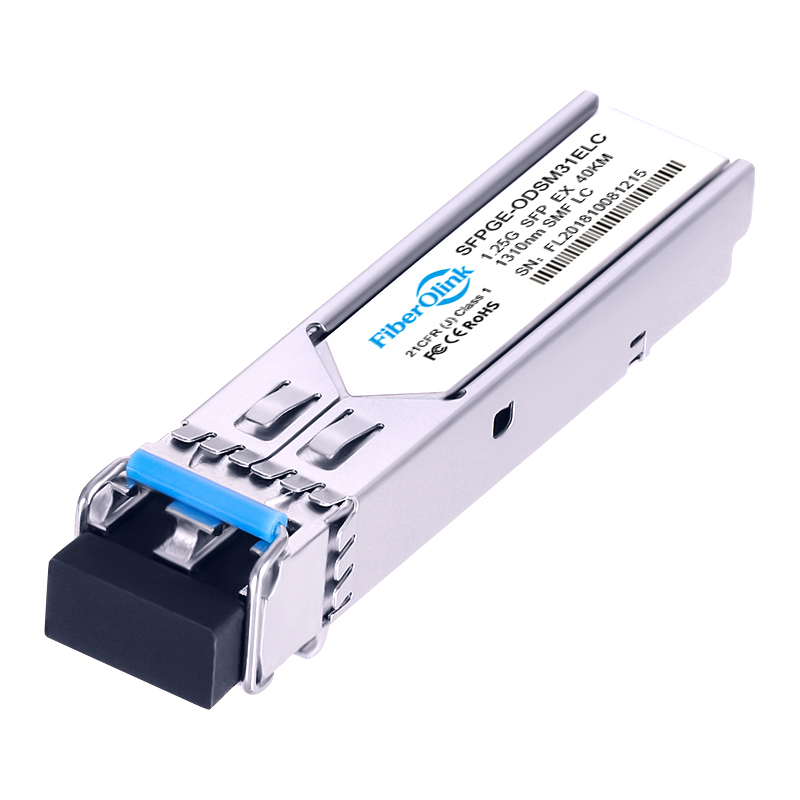
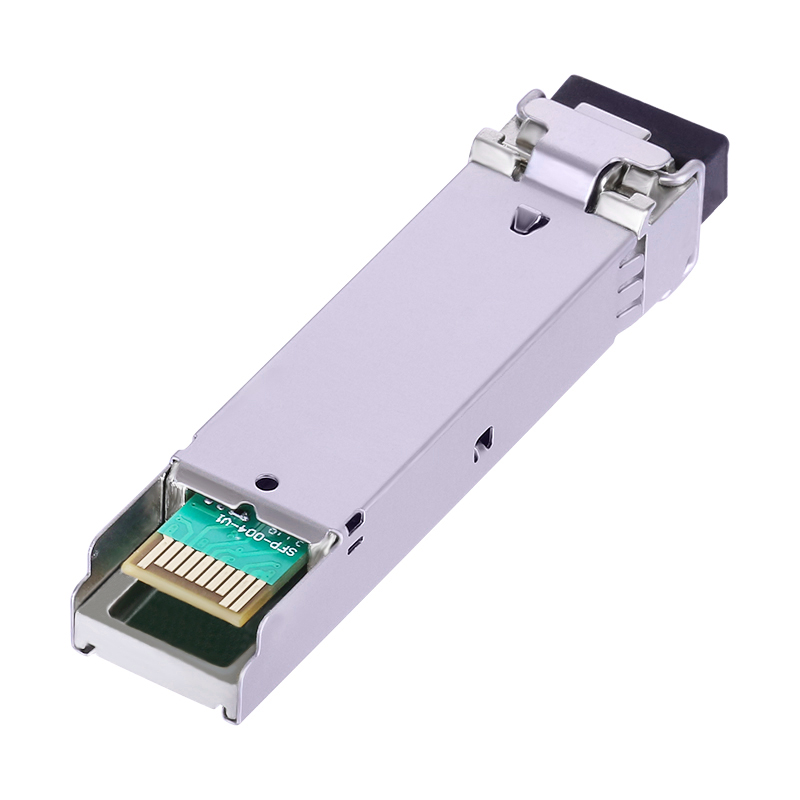
1.25G SFP EX 1310nm 40Km
- Utilizes hot-swappable SFP package full-duplex transceiver module
- 1310nm DFB transmitter and PIN receiver
- Compliant with IEEE 802.3z, SFF-8472, and SFP MSA Ethernet standards
- Maximum power consumption less than 0.95W
- Built-in Digital Diagnostic Monitoring (DDM)
- Power supply voltage 3.3V
- Compliant with RoHS environmental standards (lead-free)
- Class 1/1M specification products, compliant with IEC60825-1 requirements
- Meets Telcordia (Bellcore) GR-468-CORE reliability requirements
- Meets EMI and ESD requirements
Warranty : 30-Day Free Return, 3-Year Free Replacement, 5-Year Warranty, Lifetime After-sales Technical Support.
| Product Model | SFP-1G-EX-31 | Vendor Name | Fiberolink |
| Form Factor | SFP | Data Rate | 1.25Gbps |
| Wavelength | 1310nm | Distance | 40km |
| Connector | LC Duplex | Cable Type | SMF |
| Transmitter Type | DFB | Detector Types | PIN |
| TX Power | -5~0dBm | Receiver Sensitivity | < -24dBm |
| Power Consumption | ≤0.95W | Operation Temperature | 0~70°C |
| DDM | Support | EMC | Support |
| Protocols | IEEE 802.3z, SFF-8472, SFP MSA, CPRI, eCPRI | ||
Differences Between SFP Ports and RJ45 Ports
While both SFP ports and RJ45 ports can support a maximum transmission rate of 1000Mbps, there are some distinctions between the two.
- Application Differences
For instance, on a switch, an SFP port requires pairing with an SFP optical module and the use of fiber patch cords for data transmission; conversely, an RJ45 port on a switch allows for direct data transmission via Ethernet cables.
- Transmission Distance Variations
RJ45 ports primarily utilize Ethernet cables for data transmission, with their maximum transmission distance limited to that of the cable itself, typically around 100 meters. On the other hand, SFP ports necessitate the use of SFP optical modules connected to fiber patch cords for transmission, with the maximum distance being determined by the module’s capabilities, often extending up to 160 meters.
Note: When using single-mode fiber (SMF) over shorter distances, an optical attenuator may need to be inserted into the link to prevent receiver overload.
Moreover, in terms of port flexibility, scalability, and overall cost effectiveness, SFP tends to outperform RJ45, whether considering the ports themselves or the network equipment (like switches).
Q、What types of SFP optical modules are there?
A、SFP optical modules are small form-factor pluggable transceiver units widely used in the telecommunications sector, available in numerous varieties including BIDI-SFP, Ethernet SFP, CWDM SFP, DWDM SFP, and SFP+ modules. Furthermore, compared to similar XFP, X2, and XENPAK modules, SFP modules not only offer direct compatibility but are also more cost-efficient.
Q、What is an SFP optical module?
A、SFP optical modules feature a hot-pluggable small form factor, with current maximum speeds reaching 10G and commonly using LC connectors. SFP stands for Small Form-factor Pluggable, which can be seen as an upgraded version of GBIC. The SFP module has a volume half that of GBIC, allowing for twice as many ports on the same panel.
Q、What components constitute an SFP optical module?
A、An SFP optical module comprises a laser diode, a PCB IC, and external components, which include the casing, unlock mechanism, latches, base, pull tab, rubber dust cap, and PCBA. The color of the pull tab can help identify the module’s specification type.
Related products
-
 1.25G SFP CWDM
1.25G CWDM SFP 160km
-
 1.25G SFP BiDi
1.25G BIDI SFP LX 1310Tx 1490Rx 40km
-
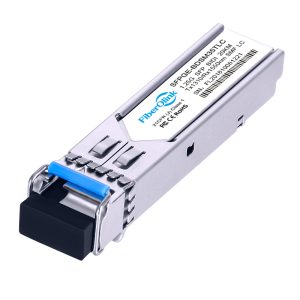 1.25G SFP BiDi
1.25G BIDI SFP LX 1310Tx 1490Rx 10km
-
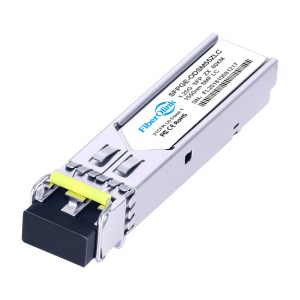 155M-1.25G SFP Duplex
1.25G SFP ZX 1550nm 80km