



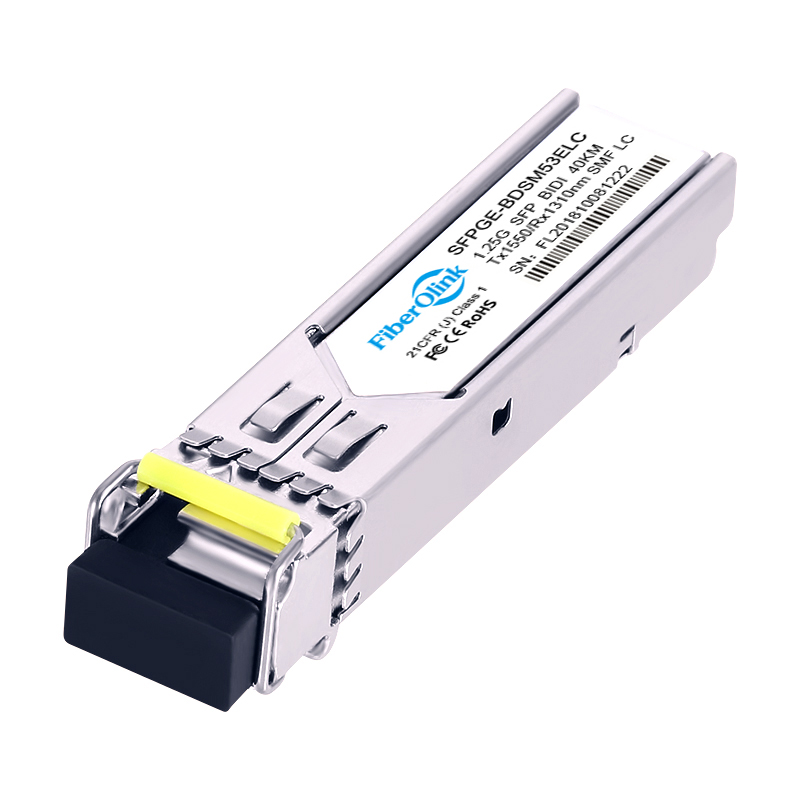
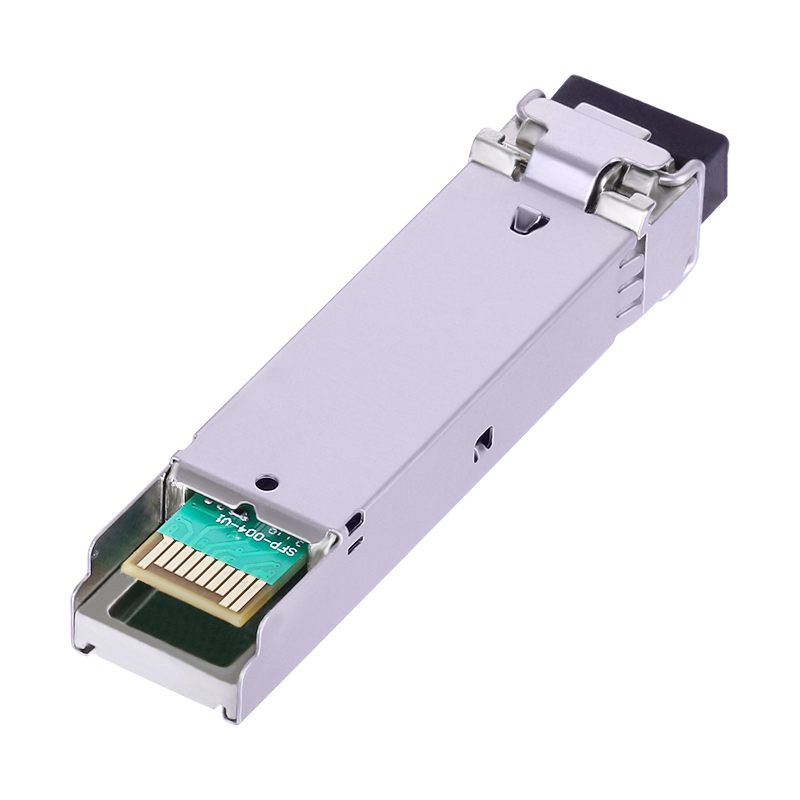
1.25G BIDI SFP LX 1550Tx 1310Rx 40km
- Utilizes hot-swappable SFP packaging simplex transceiver module
- 1550nm DFB transmitter and PIN receiver
- Compliant with IEEE 802.3z, SFF-8472, and SFP MSA Ethernet standards
- Maximum power consumption less than 0.86W
- Built-in Digital Diagnostic Monitoring (DDM)
- Power supply voltage 3.3V
- Compliant with RoHS environmental standards (lead-free)
- Class 1/1M specification product, compliant with IEC60825-1 requirements
- Meets Telcordia (Bellcore) GR-468-CORE reliability requirements
- Meets EMI and ESD requirements
- MTBF: 800,000 hours
Warranty : 30-Day Free Return, 3-Year Free Replacement, 5-Year Warranty, Lifetime After-sales Technical Support.
| Product Model | SFP-1G-BIDI-40 | Vendor Name | Fiberolink |
| Form Factor | SFP | Data Rate | 1.25Gbps |
| Wavelength | TX-1550nm/RX-1310nm | Distance | 40km |
| Connector | LC Simplex | Cable Type | SMF |
| Transmitter Type | DFB | Receiver Type | PIN |
| TX Power | -5~0dBm | Receiver Sensitivity | < -24dBm |
| Power Consumption | ≤0.86W | Operation Temperature | 0~70°C |
| DDM | Support | EMC | Support |
| Protocols | IEEE 802.3z, SFF-8472, SFP MSA, CPRI, eCPRI | ||
Differences between SFP Ports and RJ45 Ports
While both SFP ports and RJ45 ports boast a maximum transmission rate of 1000Mbps, there are subtle distinctions between the two.
Application Variations
For instance, on a switch, an SFP port requires an accompanying SFP optical module and fiber patch cord for data transmission; conversely, an RJ45 port on a switch can directly facilitate data transfer via an Ethernet cable.
Difference in Transmission Distance
RJ45 ports primarily transmit data through Ethernet cables, with their maximum transmission distance capped at the cable’s limit, typically 100 meters. In contrast, SFP ports leverage SFP optical modules and fiber jumpers for transmission, where the maximum distance is determined by the SFP module’s capabilities, often reaching up to 160 meters.
Note: When using single-mode fiber (SMF) for shorter distances, an optical attenuator may be required in the link to prevent receiver overload.
Furthermore, in terms of flexibility, scalability, and cost-effectiveness—both at the port level and in networking equipment like switches—SFP offers advantages over RJ45.
Q、Can an SFP port connect to an RJ45 port?
A: Yes. To illustrate, connecting a 1G SFP switch to a 1G RJ45 switch can be achieved by employing a Gigabit Ethernet Copper Module on the 1G SFP switch side. This module features one end with an SFP interface designed to plug into the 1G SFP switch, and the other end with an RJ45 connector. Simply connect the module’s RJ45 side to the RJ45 port of the 1G RJ45 switch using an Ethernet cable.
1.25Gbs SFP BIDI 10km Transceiver HXSX-1L355313x
1.25Gbs SFP BIDI 20km Transceiver HXSX-1L344323x
1.25Gbs SFP BIDI 20km Transceiver HXSX-1L355323x
1.25Gbs SFP BIDI 40km Transceiver HXSX-1L344343x
1.25Gbs SFP BIDI 40km Transceiver HXSX-1L355343x
1.25Gbs SFP BIDI 60km Transceiver HXSX-1L344363x
1.25Gbs SFP BIDI 80km Transceiver HXSX-1L455483x
1.25Gbs SFP BIDI 100km Transceiver HXSX-1L4554W3x
Related products
-
 1.25G SFP BiDi
1.25G BIDI SFP+ ZX 1550Tx 1490Rx 80km
-
 1.25G SFP BiDi
1.25G BIDI SFP LX 1310Tx 1490Rx 10km
-
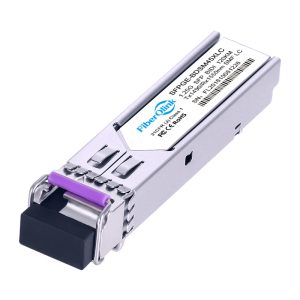 1.25G SFP BiDi
1.25G BIDI SFP 1490Tx 1550Rx 120km
-
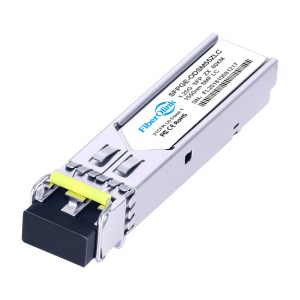 155M-1.25G SFP Duplex
1.25G SFP ZX 1550nm 80km