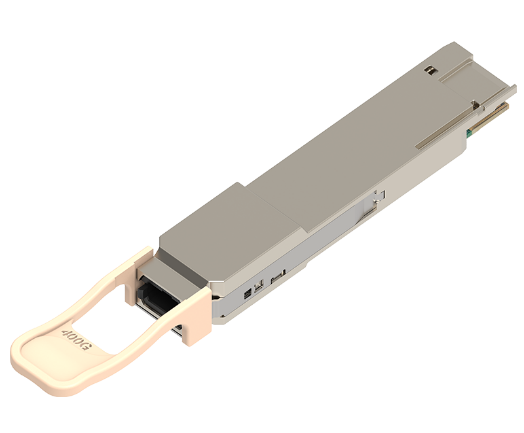



If the Server’s Module is OSFP and the Switch’s is QSFP112, can it be Linked by Cables to Connect Data?
Yes, but you need to use a specific fiber optic transceiver and cable, as well as a port split configuration on the switch side.
OSFP and QSFP112 are both fiber optic transceivers that support 400G data rates, but they have different sizes and interfaces. The OSFP transceiver can split a 400G signal into four 100 Gb/s signals or combine four 100 Gb/s signals into a single 400 Gb/s signal, while the QSFP112 transceiver can split a 400 Gb/s signal into two 200 Gb/s signals or combine two 200 Gb/s signals into a single 400G signal. The QSFP112 transceiver can split a 400 Gb/s signal into two 200G signals or combine two 200G signals into a 400 Gb/s signal.
Therefore, to realize the connection of OSFP on the server side and QSFP112 on the switch side, you need to use a 1-to-2聽cable. One end of the cable has an OSFP interface, and the other end has two QSFP112 interfaces, so that the 400G signal from the OSFP transceiver can be split into two 200 Gb/s signals, and then connected to the two QSFP112 transceivers respectively.
At the same time, you need to do port splitting configuration on the switch side to split one NDR port into two NDR200 ports.
In this way, data communication between the server and the switch can be realized.
FAQS
Q: 400G QSFP-DD vs 400G OSFP/CFP8: What are the differences?
A: The table below includes detailed comparisons for the three main form factors of 400G transceivers.
| 400G Transceiver | 400G QSFP-DD | 400G OSFP | CFP8 |
|---|---|---|---|
| Application Scenario | Data center | Data center & telecom | Telecom |
| Size | 18.35mm× 89.4mm× 8.5mm | 22.58mm× 107.8mm× 13mm | 40mm× 102mm× 9.5mm |
| Max Power Consumption | 12W | 15W | 24W |
| Backward Compatibility with QSFP28 | Yes | Through adapter | No |
| Electrical signaling (Gbps) | 8× 50G | ||
| Switch Port Density (1RU) | 36 | 36 | 16 |
| Media Type | MMF & SMF | ||
| Hot Pluggable | Yes | ||
| Thermal Management | Indirect | Direct | Indirect |
| Support 800G | No | Yes | No |
Q: How does the QSFP+ to SFP+ fiber convertor allow 4x 10G?
A: To enable 4x 10G connectivity, a QSFP+ to SFP+ fiber converter utilizes a breakout cable. This cable splits the 40G channel provided by the QSFP+ transceiver into four individual 10G channels, each connected to an SFP+ transceiver. Essentially, the converter breaks down the high-speed 40G signal into four separate 10G signals, allowing each SFP+ port to transmit data at 10G speeds. This configuration is beneficial for scenarios where equipment with SFP+ interfaces needs to communicate with a device equipped with a QSFP+ port, providing flexibility and compatibility in networking setups.
Q: What does “SR8”, “DR4”, “XDR4”, “FR4”, and “LR4” mean?
A: “SR” refers to short range, and “8” implies there are 8 optical channels. “DR” refers to 500m reach using single-mode fiber, and “4” implies there are 4 optical channels. “XDR4” is short for “eXtended reach DR4”. And “LR” refers to 10km reach using single-mode fiber.
Q: Can I plug an OSFP transceiver module into a QSFP-DD port?
A: No. QSFP-DD and OSFP are totally different form factors. For more information about QSFP-DD transceivers, you can refer to 400G QSFP-DD Transceiver Types Overview. You can use only one kind of form factor in the corresponding system. E.g., if you have an OSFP system, OSFP transceivers and cables must be used.
Q: What other breakout options are possible apart from using OSFP modules mentioned above?
A: OSFP 400G DACs & AOCs are possible for breakout 400G connections. See 400G Direct Attach Cables (DAC & AOC) Overview for more information about 400G DACs & AOCs.
Q1: What is the difference between QSFP28 ER4 and QSFP28 ER4 Lite Module?
A: The QSFP 100G ER4 has a series of BER requirements of better than 1E-12 without FEC optical modules. However, the receiving sensitivity of 100G QSFP28 ER4 is not satisfied with the existing APD technology. Therefore, many optical module manufacturers/suppliers defined a non-standard 100Gbase ER4 Lite module with a QSFP28 package where the largest transmission distance is up to 40km with FEC or 30km without FEC.?Walsun provides the QSFP28 100G ER4 Lite module compliant with the Ethernet 100Gbase ER4 Lite standard to meet the harshest external operating conditions including temperature, humidity, and EMI interference.
Q2: How does the QSFP 100G ER4 Module differ from the QSFP28 4WDM?
A: The QSFP 100G ER4 optical transceiver supports dual 100G Ethernet applications while the 100G QSFP28 4DWM only supports 100G Ethernet applications. The commons and differences are listed below.
| Form Type | QSFP28 ER4 | QSFP28 4WDM | ||
|---|---|---|---|---|
| Max Data Rate | 25.78125Gbps/27.95Gbps | 25.78125Gbps | ||
| Max Cable Distance | 40km | 10km | 20km | 40km |
| Center Wavelength | 1295.56nm, 1300.05nm, 1304.58nm, 1309.14nm | 1271nm, 1291nm, 1311nm, 1331nm | 1295.56nm, 1300.05nm, 1304.58nm, 1309.14nm | 1295.56nm, 1300.05nm, 1304.58nm, 1309.14nm |
| FEC Requirement | Without FEC (BER 1E-12) | With FEC (BER 5E-5) | ||
| Receiver | SOA+PIN ROSA | PIN ROSA | PIN ROSA | APD ROSA |
| Cooling Requirement | Cooled | Uncooled | Cooled | Cooled |