


Although single mode fiber (SMF) and multimode fiber (MMF) optic cable types are widely used in diverse applications, the differences between single mode fiber and multimode fiber optic cables are still confusing. This article will focus on the basic construction, fiber distance, cost, fiber color, etc., to make an in-depth comparison between single mode and multimode fiber types.
Differences in Construction
First the basics…. single mode fiber is designed to propagate a single light mode whereas multimode supports multiple simultaneous light modes. This difference impacts bandwidth, signal transmission distance and signal stability which we’ll explore later.
Additionally, single mode and multimode cables are built differently. The optical core in a single mode cable is 9µm and the optical core in a modern multimode cable is 50µm, though older fiber cables (specifically OM1 rated cables) features a 62.5µm core.

The smaller core size in single mode leads to lower attenuation and therefore longer transmission distances and higher bandwidths. The physics are straight forward: a smaller pipe means less signal reflection.

Differences in Bandwidth
If bandwidth is important to you — and it should be — single mode is the clear winner. Single mode cables support brighter, more power light sources with lower attenuation. Plus, a single light mode provides theoretically unlimited bandwidth.
Multimode, on the other hand, relies on the transmission of multiple light modes with less brightness and higher attenuation. This caps the bandwidth and leads to five grades of multimode fiber each with difference bandwidth and distance capabilities. The industry generally ranks the cable and network electronics as follows:
Single Mode vs Multimode Fiber Distance
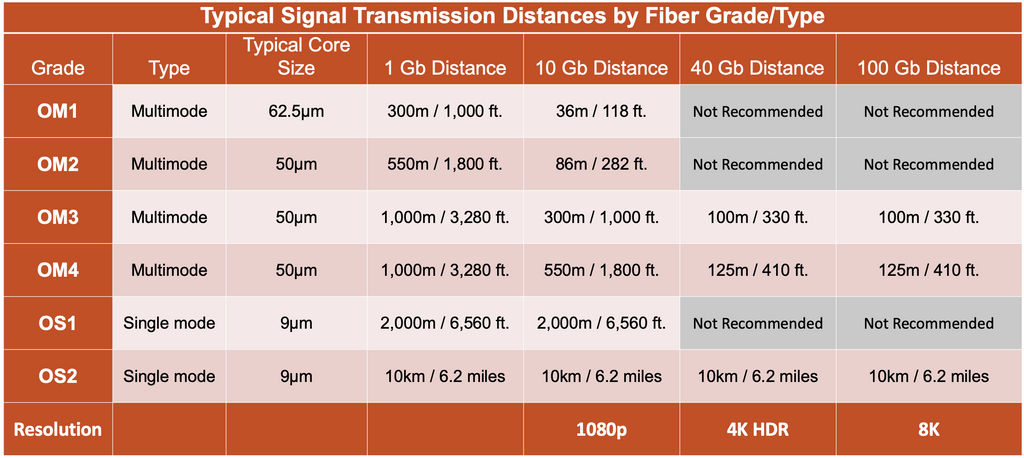
It’s known that single mode fiber is suitable for long-distance applications, while multimode optical fiber is designed for short-distance runs. Then when it comes to single mode vs multimode fiber distance, what’s the quantifiable differences?
| Fiber Optic Cable Type | Fiber Distance | |||||||
|---|---|---|---|---|---|---|---|---|
| Fast Ethernet 100BA SE-FX | 1Gb Ethernet 1000BASE-SX | 1Gb Ethernet 1000BA SE-LX | 10Gb Base SE-SR | 25Gb Base SR-S | 40Gb Base SR4 | 100Gb Base SR10 | ||
| Single mode fiber | OS2 | 200m | 5,000m | 5,000m | 10km | / | / | / |
| Multimode fiber | OM1 | 200m | 275m | 550m (mode conditioning patch cable required) | / | / | / | / |
| OM2 | 200m | 550m | / | / | / | / | ||
| OM3 | 200m | 550m | 300m | 70m | 100m | 100m | ||
| OM4 | 200m | 550m | 400m | 100m | 150m | 150m | ||
| OM5 | 200m | 550m | 300m | 100m | 400m | 400m | ||
From the chart, we can see that single mode fiber distance is much longer than that of multimode fiber cables at the data rate from 1G to 10G, but OM3/OM4/OM5 multimode fiber supports a higher data rate. Because multimode optical fiber has a large core size and supports more than one light mode, its fiber distance is limited by modal dispersion which is a common phenomenon in multimode step-index fiber. While single mode fiber is not. That’s the essential difference between them. In addition, OS2 single mode fiber could support longer distances in 40G and 100G links, which is not listed in the table.
Picking a Cable
So what’s better? Single mode or multimode fiber? Well, they are different…. Single mode cable is less expensive, supports higher bandwidths and longer distances; however, the cost of electronics is greater.

In practice, we see more integrators choosing single mode over multimode for building prewires, networking, AV distribution, security, broadcast, and most other applications.
Most electronics will support either cable type provided the proper transceiver module is used and distance limitations are respected, though it’s always best to check with your intended device prior to integrating a cable.
Walsun electronics and enclosures are compatible with both single mode and multimode fiber.
Additionally, all Walsun tools — including the termination and test kits — are compatible with both single mode and multimode.
Connectors, couplers and adapters are specific to cable type.
Frequently Asked Question about Single Mode vs Multimode Fiber Optic Cable
Q: What is better single mode or multimode fiber type?
A: As has been mentioned above, single mode fiber and multimode fiber cable have their own advantages on cost and applications. There is no such thing that single mode optical fibers are better than multimode ones. Just choosing the best-fit one for your applications is ok.
Q: Can I mix single mode and multimode fiber type?
A: This answer for this question is “no”. Multimode fiber and single mode fiber have different core sizes, and the number of light modes that they transmit is also different. If you mix the two fibers, or connect them together directly, you’ll lose a large amount of optical loss, resulting in a link flapping or being down. Keep in mind that never mix different types of cabling randomly.
Q: Can I use a multimode transceiver on single mode fiber optic cable?
A: Generally speaking, the answer is “no”. Large optical loss will occur if a multimode transceiver is connected with single mode fiber. However, the opposite will work. For example, 1000BASE-LX single mode SFP can work on multimode fiber cable by using mode conditioning fiber cable. Sometimes, fiber media converters also can be used to solve such problems between single mode transceivers and multimode transceivers.
Q: Single mode vs multimode fiber optic cable type: which should I choose?
A: When making a decision between single mode and multimode fiber cables, the first factor to consider is the fiber distance which you need actually. For example, in a data center, multimode fiber cables are enough for the distance of 300-400 meters. While in applications that require distance up to several thousands of meters, the single mode fiber is the best choice. And in applications that can use single mode and multimode fiber, other factors like cost and future upgrade requirements should be taken into consideration for your choice.
Related Article: