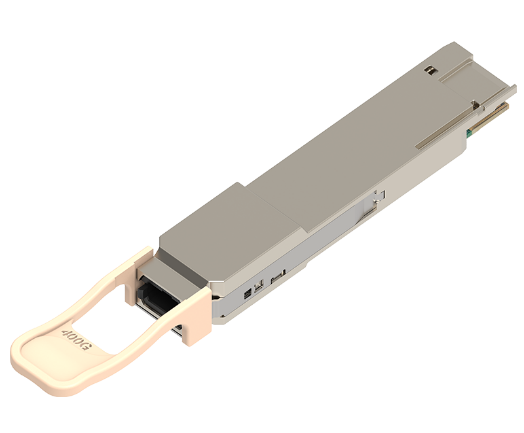



400G optical transceivers are high-speed modules designed to meet the needs of data centers, telecommunications, and enterprise networks for higher bandwidth and data transmission rates. These transceivers are essential for enabling 400 Gigabit Ethernet (400GbE) connections and come in various form factors, including QSFP-DD, OSFP, and CFP8. They support different types of transmission distances and applications, leveraging wavelengths of 850nm, 1310nm, or 1550nm, and technologies such as PAM4 (Pulse Amplitude Modulation) to achieve high data rates.
Table of Contents
ToggleQ: What 400G transceivers are available from Walsun?
A: Walsun supports a full range of 400G optical transceivers in both OSFP and QSFP-DD form factors, 400G AOCs and DACs, and 400G breakout cables. The tables below summarize the 400G connectivity options Walsun supports.
| Category | Product | Max Cable Distance | Connector | Media | Power Consumption |
| 400G Transceivers | 400G QSFP-DD SR8 | 70m@OM3/100m@OM4 | MTP/MPO-16 (APC) | MMF | ≤10W |
| 400G QSFP-DD DR4 | 500m | MTP/MPO-12 (APC) | SMF | ≤10W | |
| 400G QSFP-DD XDR4 | 2km | MTP/MPO-12 | SMF | ≤12W | |
| 400G QSFP-DD FR4 | 2km | Duplex LC | SMF | ≤12W | |
| 400G QSFP-DD LR4 | 10km | Duplex LC | SMF | ≤12W | |
| 400G QSFP-DD PLR4 | 10km | MTP/MPO-12 | SMF | ≤10W | |
| 400G QSFP-DD LR8 | 10km | Duplex LC | SMF | ≤14W | |
| 400G QSFP-DD ER8 | 40km | Duplex LC | SMF | ≤14W | |
| 400G OSFP SR8 | 100m | MTP/MPO-16 | MMF | ≤12W | |
| 400G OSFP DR4 | 500m | MTP/MPO-12 (APC) | SMF | ≤10W | |
| 400G Cables | 400G QSFP-DD DAC/AOC | 100m | QSFP-DD | / | ≤11W |
| 400G Breakout DAC/AOC | 50m | QSFP-DD to 2x QSFP56, QSFP-DD to 4x QSFP56, QSFP-DD to 4x QSFP28, QSFP-DD to 8x SFP56 | / | ≤11W |
1. What is a 400G transceiver?
A 400G transceiver is an optical module designed to support 400 Gigabit Ethernet (400GbE) data rates. These modules are used in data centers, telecommunications, and enterprise networks to enable high-speed data transmission over optical fiber.
2. What are the common form factors for 400G transceivers?
Common form factors for 400G transceivers include:
- QSFP-DD (Quad Small Form-factor Pluggable Double Density)
- OSFP (Octal Small Form-factor Pluggable)
- CFP8 (C Form-factor Pluggable 8)
3. What types of 400G transceivers are available?
400G transceivers are available in various types to meet different distance and application requirements:
- 400G SR8: For short-reach up to 100m over MMF (Multi-Mode Fiber).
- 400G DR4: For medium-reach up to 500m over SMF (Single-Mode Fiber).
- 400G FR4: For long-reach up to 2km over SMF.
- 400G LR4: For extended reach up to 10km over SMF.
- 400G ZR: For ultra-long reach up to 80km over SMF.
4. What is the difference between QSFP-DD and OSFP?
- QSFP-DD: This form factor is similar to the traditional QSFP but with double the density, supporting up to 400 Gbps. It is backward compatible with QSFP28 and QSFP+.
- OSFP: Designed for higher power consumption and thermal performance, OSFP supports up to 400 Gbps and is slightly larger than QSFP-DD, making it suitable for higher density applications.
5. How do 400G transceivers achieve high data rates?
400G transceivers use advanced modulation techniques like PAM4 (Pulse Amplitude Modulation 4-level) to achieve higher data rates. PAM4 allows the transmission of more data by encoding two bits per symbol, effectively doubling the data rate compared to traditional NRZ (Non-Return to Zero) modulation.
6. What is PAM4 modulation?
PAM4 (Pulse Amplitude Modulation 4-level) is a modulation technique that uses four distinct signal levels to encode data. This allows for the transmission of two bits per symbol, effectively doubling the data rate over the same bandwidth compared to NRZ (Non-Return to Zero) modulation, which uses only two levels.
7. What are the power consumption and thermal requirements for 400G transceivers?
400G transceivers typically consume up to 12W of power. Effective thermal management is crucial, especially in high-density deployments, to ensure optimal performance and reliability. Modules are designed with advanced cooling mechanisms to handle the increased power dissipation.
8. What are the typical applications of 400G transceivers?
400G transceivers are used in:
- Data Centers: For high-speed connectivity between servers, switches, and storage systems.
- Telecommunications: In backbone networks for high-capacity data transmission.
- Enterprise Networks: To upgrade core and aggregation layers.
- High-Performance Computing (HPC): For fast data exchange in supercomputing environments.
9. Are 400G transceivers backward compatible?
Yes, QSFP-DD and OSFP transceivers are designed to be backward compatible with lower-speed modules such as QSFP28 (100G) and QSFP+ (40G), allowing for seamless integration with existing network infrastructure.
10. What is the typical lifespan of a 400G transceiver?
The lifespan of a 400G transceiver depends on various factors, including usage, environmental conditions, and handling. Generally, they are designed to last several years, with warranties typically ranging from 1 to 3 years, depending on the manufacturer.
11. What is Digital Diagnostic Monitoring (DDM)?
Digital Diagnostic Monitoring (DDM) is a feature that allows real-time monitoring of a transceiver’s operating parameters, such as temperature, voltage, laser bias current, and optical output power. This helps in proactive network management and troubleshooting.
12. How do I choose the right 400G transceiver for my network?
Choosing the right 400G transceiver depends on several factors:
- Transmission distance: Select based on the required reach (e.g., SR8 for short reach, LR4 for long reach).
- Fiber type: Choose based on the type of optical fiber (MMF or SMF) in your network.
- Form factor: Ensure compatibility with your network equipment (e.g., QSFP-DD, OSFP).
- Application: Consider the specific application and bandwidth requirements.
13. Are 400G transceivers RoHS compliant?
Yes, most 400G transceivers are RoHS compliant, meaning they adhere to the Restriction of Hazardous Substances directive, which limits the use of specific hazardous materials in electronic equipment.
14. What are the benefits of upgrading to 400G transceivers?
Upgrading to 400G transceivers offers several benefits:
- Increased bandwidth: Supports higher data rates for bandwidth-intensive applications.
- Higher density: More efficient use of space in networking equipment.
- Future-proofing: Prepares the network for future growth and higher data demands.
- Lower latency: Enhances performance in latency-sensitive applications.