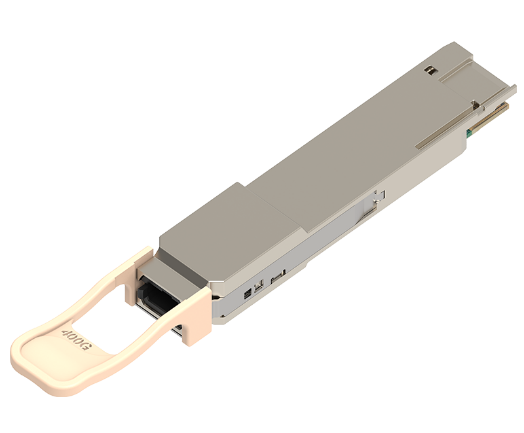



ExtremeCompatible40G QSFP+ ZR4 Lite CWDM4 Optical Transceiver Module (1271nm, 1291nm, 1311nm, 1331nm SMF 60km LC DDM)
The 40G QSFP+ ZR4 Lite is a 60km optical communication application transceiver module. The design is compliant with 40GBASE-ER4 of the IEEEP802.3ba standard. The module converts 4 input channels of 10Gb/s electrical datato4CWDM optical signals and multiplexes them into a single channel for 40Gb/s optical transmission. On the receiver side, the module optically de-multiplexes a 40Gb/s input into 4 CWDM channel signals and converts them to 4-channel output electrical data.
Table of Contents
ToggleProduct Details
| Fiber Mall P/N | QSFPP-40G-ZR4-Lite | Vendor Name | Walsun |
| Form Factor | QSFP+ | Max Data Rate | 40Gbps |
| Wavelength | 1271nm, 1291nm 1311nm, 1331nm |
Max Distance | 60km |
| Connector | LC Duplex | Transmitter Type | CWDM DFB |
| Cable Type | SMF | Receiver Type | APD |
| TX Power | +3.0~+7.0dBm | Receiver Sensitivity | < -23.0dBm |
| Protocols | 40G Ethernet IEEE802.3ba and 40GBASE-ZR4 Lite, MSA, QDR/DDR Infiniband | Operation Temperature | 0 to 70°C (32 to 158°F) |
What is the difference between QSFP28 and 100G QSFP?
They are the same. The “QSFP” form factor was originally defined for <10G speeds. When it was adopted for 40G, the name became QSFP+ to denote the higher aggregate performance. The same “QSFP” form factor was later adopted for 100G but the electrical interface had to be upgraded to handle 25Gbps/lane. The electrical interface for 100G can handle up to 28Gbps, hence the engineering and industry name is QSFP28. Walsun refers to the 100G form factor as “100G QSFP” to avoid any confusion.
Which 100G QSFPs are capable of supporting link distances over 10km?
The Walsun QSFP-100G-ZR4 supports link distances up to 80km. A minimum of 12dB attenuation is required to prevent permanent damage to the receiver – refer to the optics datasheet for optical specs. The QSFP-100G-ZR4 is supported on a limited set of platforms – refer to the Transceiver and Cable Guide for supported platforms. The Walsun QSFP-100G-ERL4 supports link distances up to 40km when the forward error correction (FEC) is enabled on the host switch / router. In the default no-FEC mode, QSFP-100G-ERL4 supports a reach of up to 30km. A minimum of ~10dB attenuation is required to guarantee the receiver is not damaged. Please refer to the optics datasheet for optical specifications. The QSFP-100G-LR4 supports links up to 10km over duplex single mode fiber. Enabling FEC with QSFP-100GLR4 optics on Walsun switches can allow for links beyond 10km with single mode fiber. However, as this is not fully characterized, customers are advised to measure the link distance and optical loss budget before deploying.
What are the types and specifications of QSFP28 transceivers?
The types and main specifications of 100G QSFP28 are shown in the following diagram.
| QSFP28 | Industry Standards | Max Cable Distance | Optical Connector | Fiber Type to Be Used |
|---|---|---|---|---|
| 100GBASE-SR4 | IEEE 802.3bm, QSFP28 MSA, SFF-8665, SFF-8636, RoHS, CPRI, eCPRI | 100m | MTP/MPO-12 | MMF |
| 100GBASE-LR4 | IEEE 802.3ba 100GBASE-LR4, IEEE 802.3bm, QSFP28 MSA, SFF-8665, SFF-8636 | 10km | LC Duplex | SMF |
| 100GBASE-ER4 | QSFP28 MSA Compliant | 40km | LC Duplex | SMF |
| 100GBASE-ZR4 | QSFP28 MSA Compliant | 80km | LC Duplex | SMF |
| 100GBASE-DR | IEEE 802.3cd 100GBASE-DR Specification compliant | 500m | LC Duplex | SMF |
| 100GBASE-FR | 100G Lambda MSA 100G-FR Specification compliant | 2km | LC Duplex | SMF |
| 100GBASE-LR | 100G Lambda MSA 100G-LR Specification compliant | 10km | LC Duplex | SMF |
| 100GBASE-PSM4 | QSFP28 MSA Compliant | 500m | MTP/MPO-12 | SMF |
| 100GBASE-CWDM4 | IEEE 802.3ba, IEEE 802.3bm, SFF-8665, SFF-8636, 100G CWDM4 MSA, QSFP28 MSA | 2km | LC Duplex | SMF |
| 100GBASE-4WDM | QSFP28 MSA Compliant | 10km | LC Duplex | SMF |
| 100GBASE-DWDM | IEEE 802.3bm, QSFP28 MSA, SFF-8636, SFF-8024 | 80km | CS Duplex | SMF |
| 100GBASE-BiDi | QSFP28 MSA Compliant | 20km | LC Simplex | SMF |
FAQs on 100G QSFP28 Definition and Types
Q: What does QSFP28 stand for?
A: QSFP28 is abbreviated from Quad Small Form-Factor Pluggable 28. The 100G QSFP28, implemented with four channels of high-speed differential signals with data rates ranging from 25Gbps up to potentially 40Gbps, is designed for 100 Gigabit Ethernet, EDR InfiniBand, and 32G Fibre Channel.
Q: What is the operating temperature range of 100G QSFP28 transceivers?
A: The standard operating temperature range of QSFP28 100G module commercial version is 0°C to 70°C and that of the industrial version is -40 to 85°C. Commercial version transceivers are generally applied. There are also some data centers that use 100G transceivers with operating temperatures ranging from 20°C to 50°C to reduce costs.
Q: Can I use QSFP+ optics on QSFP28 ports?
A: Yes, 100G QSFP28 ports can generally take either QSFP+ or QSFP28 optics. QSFP28 transceivers have the same form factor as the QSFP+ optical modules, and a QSFP28 module can break out into either 4x 25G or 4x 10G lanes, which depends on the transceiver used. It means that QSFP+ optics can be used on the QSFP28 ports at a lower 40G speed. However, QSFP28 modules can not be used on QSFP+ ports as the speed of the ports is lower than that of the optics used.
Q: Can 100G QSFP28 interfaces interoperate with SR10-based 100GbE?
A: No. The QSFP28 form factor has just 4 electrical lanes, which is not enough to support 10 lanes of 10G electrical interface. A QSFP 100G can only support a 4x 10G or 4x 25G electrical interface, which can be used as 4x 10GbE or 4x 25GbE, but not 10x 10GbE. As a result, the 100G QSFP28 interfaces cannot interoperate with SR10-based 100GbE transceivers.
Q: Can QSFP28 transceiver work with the CFP transceiver?
A: Yes, both are products of the Ethernet protocol and can interoperate with each other.
Q: How to achieve 100G to 4x 25G breakout application?
A: A simple 100G to 4x 25G breakout connection can be made between one QSFP28 SR4 transceiver and four SFP28 transceivers with breakout cables. In addition to 100G transceivers, breakouts can also be implemented with AOCs or DACs.
Q: Does the 100G QSFP28 need to use the FEC function?
A: Not all QSFP28 transceivers need FEC function, as the process of correcting error code will inevitably cause some data packet delay. FEC (Forward Error Correction) is a method to increase the credibility of data communication by correcting errors during signal transmission. When an error occurs in the transmission, the receiver is allowed to reconstruct the data. In the design of transceivers, the cost of FEC function is relatively high and is generally rarely used.
Related Article:
Single Rate 100G QSFP28 BIDI 850nm & 900nm 100m LC MMF DDM Optical Transceiver
Juniper Networks JNP-QSFP-100G-PSM4 Compatible 100G QSFP28 PSM4 1310nm 500m MTP-MPO SMF DDM Transceiver Module
Juniper Compatible 100G?QSFP28 ZR4+ LWDM4?100km LC SMF DDM Optical Transceiver Module
Juniper Networks QSFP-100G-ZR4 Compatible 100G?QSFP28 ZR4?1296-1309nm LWDM?80km LC SMF DDM Transceiver Module
Brocade 40G-QSFP-SR4-INT Compatible 40G QSFP+ SR4 850nm 150m MTP-MPO MMF DDM Transceiver Module