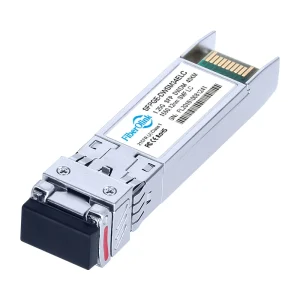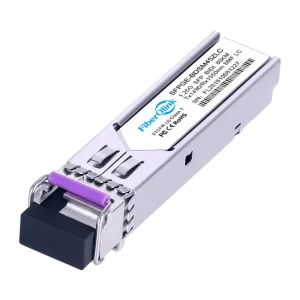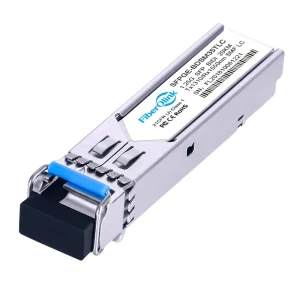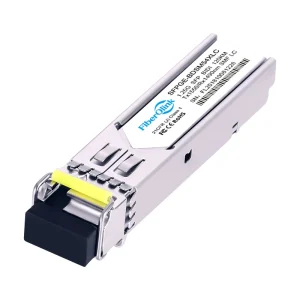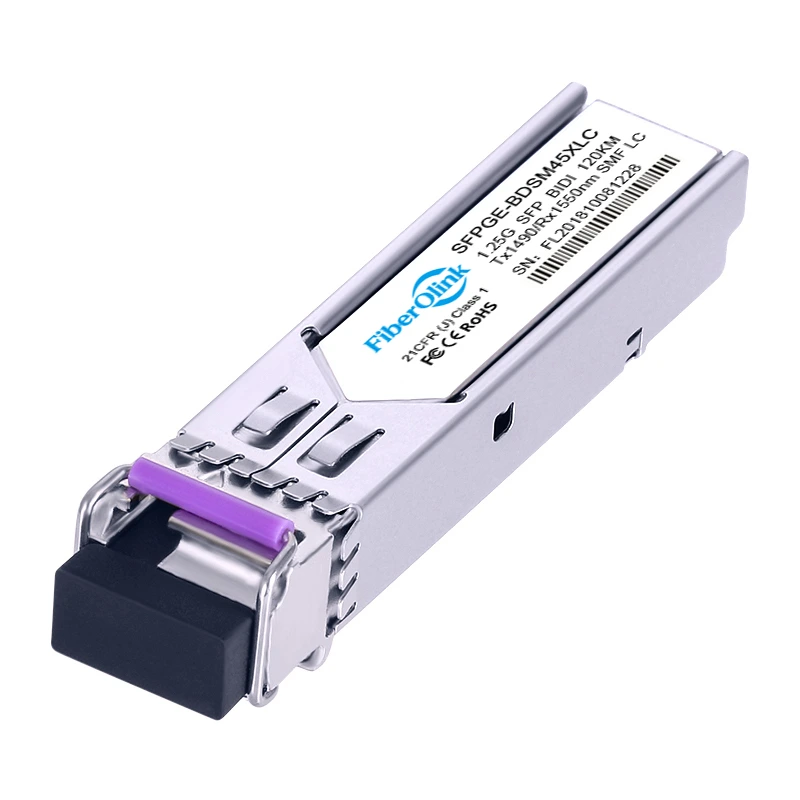
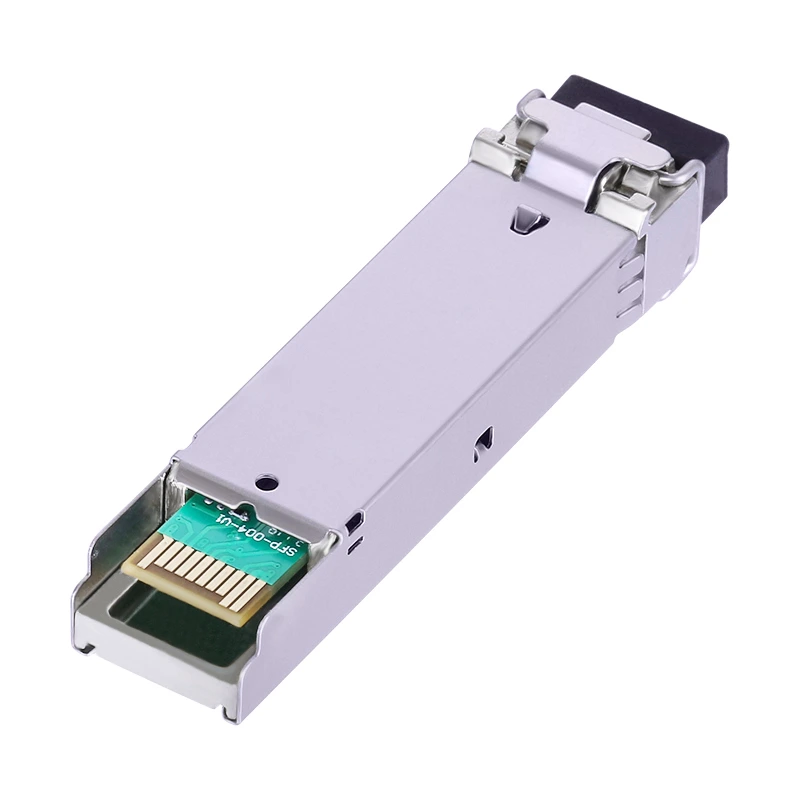
1.25G BIDI SFP 1490Tx 1550Rx 120km
- Utilizes hot-swappable SFP package single-mode transceiver module
- 1490nm DFB transmitter and APD receiver
- Compliant with IEEE 802.3z, SFF-8472, and SFP MSA Ethernet standards
- Maximum power consumption less than 0.95W
- Built-in Digital Diagnostic Monitoring (DDM)
- Power supply voltage 3.3V
- Compliant with RoHS environmental standards (lead-free)
- Class 1/1M specification products, compliant with IEC60825-1 requirements
- Meets Telcordia (Bellcore) GR-468-CORE reliability requirements
- Meets EMI and ESD requirements
- MTBF: 800,000 hours
Warranty : 30-Day Free Return, 3-Year Free Replacement, 5-Year Warranty, Lifetime After-sales Technical Support.
| Product Model | SFP-1G-BIDI-120 | Vendor Name | Fiberolink |
| Form Factor | SFP | Data Rate | 1.25Gbps |
| Wavelength | TX-1490nm/RX-1550nm | Distance | 120km |
| Connector | LC Simplex | Cable Type | 单模SMF |
| Transmitter Type | DFB | Detector Types | APD |
| TX Power | 0~5dBm | Receiver Sensitivity | < -31dBm |
| Power Consumption | ≤0.95W | Operation Temperature | 0~70°C |
| DDM | Support | EMC | Support |
| Protocols | IEEE 802.3z, SFF-8472, SFP MSA, CPRI, eCPRI | ||
Q、What types of SFP optical modules are there?
A、SFP optical modules are compact, hot-pluggable transceiver devices widely used in the telecommunications industry. They come in a variety of types, including BIDI-SFP, Ethernet SFP, CWDM SFP, DWDM SFP, and SFP+ optical modules. Moreover, compared to similar modules like XFP, X2, and XENPAK, SFP modules not only offer direct compatibility but are also more cost-effective.
Q、What is the difference between SFP+ and SFP optical modules?
A、SFP and SFP+ optical modules share a similar physical size, but the primary distinction lies in their data transfer rates. SFP modules have a maximum transmission speed of 2.5Gb/s, whereas SFP+ modules can reach up to 10Gb/s. Due to these differences in speed, their applications and transmission distances vary.
Q、Can an SFP+ optical module be used in an SFP port?
A、Yes, it is possible. A 10G SFP+ optical module can operate in an SFP port, albeit at a reduced transmission rate of 1Gbps. Conversely, SFP modules cannot be utilized in SFP+ ports.
Q、What is the difference between the electrical interface module SFP-GE-T and optical interface modules?
A、Electrical interface module SFP-GE-T and optical interface modules differ in signal transmission methods and deployment scenarios:
- Signal Transmission Method: Electrical interface modules transmit data using electrical signals, while optical interface modules employ optical signals. Optical transmission offers higher bandwidth and speed, making it suitable for long-distance communications.
- Application Environment: Electrical interface modules are better suited for short-range transmissions and smaller network settings, such as offices or home networks. Optical interface modules, on the other hand, are designed for larger-scale networks found in data centers and corporate environments.
1.25Gbs SFP BIDI 10km Transceiver HXSX-1L355313x
1.25Gbs SFP BIDI 20km Transceiver HXSX-1L344323x
1.25Gbs SFP BIDI 20km Transceiver HXSX-1L355323x
1.25Gbs SFP BIDI 40km Transceiver HXSX-1L344343x
1.25Gbs SFP BIDI 40km Transceiver HXSX-1L355343x
1.25Gbs SFP BIDI 60km Transceiver HXSX-1L344363x
1.25Gbs SFP BIDI 80km Transceiver HXSX-1L455483x
1.25Gbs SFP BIDI 100km Transceiver HXSX-1L4554W3x
Related products
-
1.25G SFP CWDM
1.25G CWDM SFP ZX 80km
-
1.25G SFP BiDi
1.25G BIDI SFP LX 1310Tx 1550Rx 40km
-
155M-1.25G SFP Duplex
1.25G SFP ZX 1550nm 80km
-
155M-1.25G SFP Duplex
1.25G SFP SX 850nm 550m