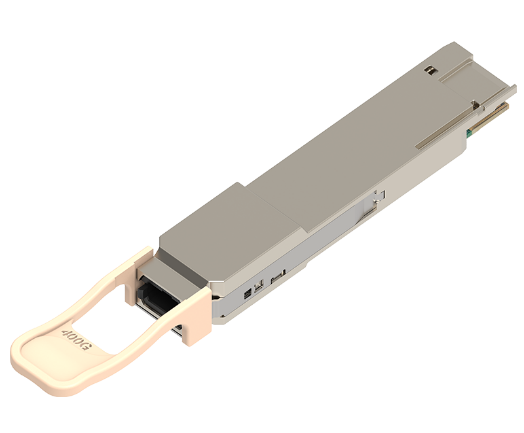



What are the Benefits of Moving to 400G Technology?
Moving to 400G (400 Gigabit Ethernet) technology can bring a multitude of benefits for networks that need to effectively handle a steep increase in traffic demand, stemming primarily from video, mobile, and cloud computing services. Some of the essential benefits are:
Increased capacity and speed: 400G offers 4 times the bandwidth of 100G, greatly bolstering network capacity and throughput for data-intensive services and applications.
Efficiency and scalability: 400G is inherently more efficient because it can carry more information per transmission. This efficiency also provides future-proofing for providers as traffic demands grow.
Cost-effectiveness: Enable 2-4X lower cost and power/bit, reducing capex and opex. Even though the upfront capital expenditure might be higher, the total cost of operation can be reduced in the long run because you can move more data with fewer devices, leading to reductions in space, power, and cooling requirements.
Improved network performance: With greater speed and capacity, 400G technology reduces latency, providing an overall improvement in network performance. This is crucial for time-sensitive applications and can significantly enhance the user experience.
Support for higher bandwidth applications: Increase switching bandwidth by a factor of 4. Migrating from 100G to 400G systems increases the bandwidth per RU from 3.2-3.6T to 12.8-14.4T / RU. The rise in high-bandwidth applications, like Ultra High Definition (UHD) video streaming, cloud services, online gaming, and virtual reality (VR), require strong, stable, and fast network connections. 400G technology can provide the necessary support for these bandwidth-intensive applications.
Enables machine-to-machine communication: 400G technology is a powerful tool for enabling machine-to-machine communications, central to the Internet of Things (IoT), artificial intelligence, and other emerging technologies.
Supports 5G networks: The higher speed and capacity of 400G technology are ideal for meeting the demanding requirements of 5G networks, helping them to achieve their full potential.
Data Center Interconnect (DCI): For enterprises operating multiple data centers at multiple sites, 400G supports efficient and powerful data center interconnection, enhancing data transfer and communication.
Sustainability: 400G is more energy-efficient than its predecessors by providing more data transmission per power unit. This is a significant advantage considering the increasing global focus on sustainability and green technology.
Enable higher-density 100G ports using optical or copper breakouts. A 32 port 1RU 400G system enables 128 100GE ports / RU. This allows a single Top of Rack (TOR) leaf switch to connect to multiple racks of servers or Network Interface Cards (NICs).
Reduce the number of optical fiber links, connectors, and patch panels by a factor of 4 when compared to 100G platforms for the same aggregate bandwidth.
In conclusion, 400G technology presents a compelling solution for networks dealing with high traffic flows due to digital transformation trends. It builds the foundation for supporting the growing demand for data from businesses and consumers alike, making it an important tool in the era of 5G, and IoT.
FAQS
Q: 400G QSFP-DD vs 400G OSFP/CFP8: What are the differences?
A: The table below includes detailed comparisons for the three main form factors of 400G transceivers.
| 400G Transceiver | 400G QSFP-DD | 400G OSFP | CFP8 |
|---|---|---|---|
| Application Scenario | Data center | Data center & telecom | Telecom |
| Size | 18.35mm× 89.4mm× 8.5mm | 22.58mm× 107.8mm× 13mm | 40mm× 102mm× 9.5mm |
| Max Power Consumption | 12W | 15W | 24W |
| Backward Compatibility with QSFP28 | Yes | Through adapter | No |
| Electrical signaling (Gbps) | 8× 50G | ||
| Switch Port Density (1RU) | 36 | 36 | 16 |
| Media Type | MMF & SMF | ||
| Hot Pluggable | Yes | ||
| Thermal Management | Indirect | Direct | Indirect |
| Support 800G | No | Yes | No |
Q: How does the QSFP+ to SFP+ fiber convertor allow 4x 10G?
A: To enable 4x 10G connectivity, a QSFP+ to SFP+ fiber converter utilizes a breakout cable. This cable splits the 40G channel provided by the QSFP+ transceiver into four individual 10G channels, each connected to an SFP+ transceiver. Essentially, the converter breaks down the high-speed 40G signal into four separate 10G signals, allowing each SFP+ port to transmit data at 10G speeds. This configuration is beneficial for scenarios where equipment with SFP+ interfaces needs to communicate with a device equipped with a QSFP+ port, providing flexibility and compatibility in networking setups.
Q: What does “SR8”, “DR4”, “XDR4”, “FR4”, and “LR4” mean?
A: “SR” refers to short range, and “8” implies there are 8 optical channels. “DR” refers to 500m reach using single-mode fiber, and “4” implies there are 4 optical channels. “XDR4” is short for “eXtended reach DR4”. And “LR” refers to 10km reach using single-mode fiber.
Q: Can I plug an OSFP transceiver module into a QSFP-DD port?
A: No. QSFP-DD and OSFP are totally different form factors. For more information about QSFP-DD transceivers, you can refer to 400G QSFP-DD Transceiver Types Overview. You can use only one kind of form factor in the corresponding system. E.g., if you have an OSFP system, OSFP transceivers and cables must be used.
Q: What other breakout options are possible apart from using OSFP modules mentioned above?
A: OSFP 400G DACs & AOCs are possible for breakout 400G connections. See 400G Direct Attach Cables (DAC & AOC) Overview for more information about 400G DACs & AOCs.
Q1: What is the difference between QSFP28 ER4 and QSFP28 ER4 Lite Module?
A: The QSFP 100G ER4 has a series of BER requirements of better than 1E-12 without FEC optical modules. However, the receiving sensitivity of 100G QSFP28 ER4 is not satisfied with the existing APD technology. Therefore, many optical module manufacturers/suppliers defined a non-standard 100Gbase ER4 Lite module with a QSFP28 package where the largest transmission distance is up to 40km with FEC or 30km without FEC.?Walsun provides the QSFP28 100G ER4 Lite module compliant with the Ethernet 100Gbase ER4 Lite standard to meet the harshest external operating conditions including temperature, humidity, and EMI interference.
Q2: How does the QSFP 100G ER4 Module differ from the QSFP28 4WDM?
A: The QSFP 100G ER4 optical transceiver supports dual 100G Ethernet applications while the 100G QSFP28 4DWM only supports 100G Ethernet applications. The commons and differences are listed below.
| Form Type | QSFP28 ER4 | QSFP28 4WDM | ||
|---|---|---|---|---|
| Max Data Rate | 25.78125Gbps/27.95Gbps | 25.78125Gbps | ||
| Max Cable Distance | 40km | 10km | 20km | 40km |
| Center Wavelength | 1295.56nm, 1300.05nm, 1304.58nm, 1309.14nm | 1271nm, 1291nm, 1311nm, 1331nm | 1295.56nm, 1300.05nm, 1304.58nm, 1309.14nm | 1295.56nm, 1300.05nm, 1304.58nm, 1309.14nm |
| FEC Requirement | Without FEC (BER 1E-12) | With FEC (BER 5E-5) | ||
| Receiver | SOA+PIN ROSA | PIN ROSA | PIN ROSA | APD ROSA |
| Cooling Requirement | Cooled | Uncooled | Cooled | Cooled |