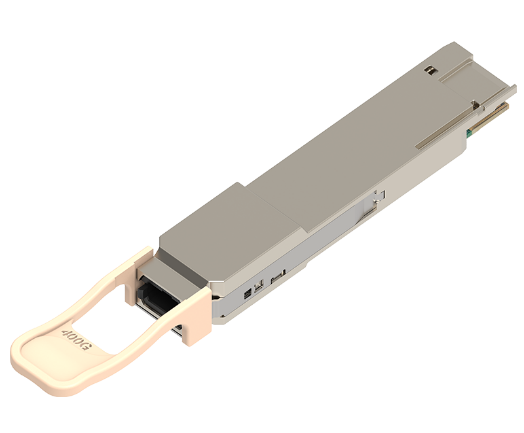



What is 100G QSFP28 Optical Transceiver?
The 100G QSFP28 optical transceiver is crafted for 100 Gigabit Ethernet, EDR InfiniBand, or 32G Fibre Channel applications. Sporting a footprint akin to the 40G QSFP+, the QSFP28 operates on four channels of high-speed data rates at 25Gbps per channel to deliver 100Gbps. Compared to 100G CFP/CFP2/CFP4, QSFP28 100G optics surpass them with the strong ability to increase density, lower power consumption, and reduced price per bit.
100G QSFP28 Definition
The 100G QSFP28 optical transceiver is designed for 100 Gigabit Ethernet, EDR InfiniBand, or 32G Fibre Channel. It generally has the exact same footprint and faceplate density as 40G QSFP+. Just as the 40G QSFP+ is implemented using four 10Gbps lanes, the 100G QSFP28 module is implemented with four channels of high-speed differential signals with data rates ranging from 25Gbps up to potentially 40Gbps. With an upgraded electrical interface, the QSFP28 100G transceiver is capable of supporting signals up to 28Gbps. QSFP 100G SR4, QSFP 100G LR4, QSFP 100G PSM4, QSFP 100G CWDM4, and QSFP 100G ER4 are the five common types of 100G QSFP28 modules designed to meet the different transmission distance requirements. Compared with 100G CFP/CFP2/CFP4 transceivers, QSFP 100G optics surpass them with the strong ability to increase density, decrease power consumption, and decrease the price per bit.
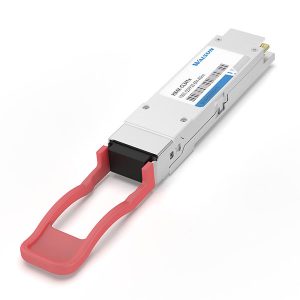
Figure 1: 100G QSFP28 Optical Transceivers
QSFP28 100G Module Standards
The 100G QSFP28 optical module standards are mainly defined by two key organizations, namely IEEE and Multi-Source Agreement (MSA). The QSFP28 SR4, QSFP28 LR4, QSFP28 ER4 are defined by the IEEE. How to clarify these three items from their names? The ‘QSFP’ means the form factor; ‘28’ represents that each lane has a maximum transmission rate of 28Gbps; ‘SR’ means short reach (100m), ‘LR’ is long reach (10km) and ‘ER’ is extended reach (40km). ‘4’ represents that the module has 4 lanes. For example, the QSFP28 LR4 means that it is a long-reach 100G module that can transmit 100G signals over four wavelengths with a transmission distance of 10km.
100GBASE-SR4 and 100GBASE-LR4 are the most commonly used 100G interface specifications defined by the IEEE. However, the transmission distance of QSFP28 SR4 is too short to meet all interconnection requirements and the cost of QSFP28 LR4 is too high for large data centers. Therefore, MSA brought a solution for mid-range connectivity to the market and defined the standards of QSFP28 PSM4 and CWDM4. Although the capability of QSFP 100G LR4 completely covers QSFP28 CWDM4, but the QSFP 100G CWDM4 solution is much cheaper and more competitive than QSFP28 LR4 in the scenario of 2km transmission.
QSFP 100G Laser Types
The laser plays an important role in the 100G QSFP28 optical transceivers which have five major types: VCSEL, FP, DFB, DML, and EML. Different types of lasers have different working wavelengths, modes and application environments.
| Laser Type | Wavelength | Working Mode | Application Scenario |
|---|---|---|---|
| VSCEL | 850nm | Surface Emitting | Within 200m |
| FP | 1310nm/1550nm | Edge Emitting | 500m-10km |
| DFB | 1310nm/1550nm | Edge Emitting | 40km |
| DML | 1310nm/1550nm | Direct Modulated | 500m-10km |
| EML | 1310nm/1550nm | Electro-absorption Modulated | 40km |
- The VCSEL laser features a small size, low power consumption, easy integration, low price, and high coupling efficiency with multimode fibers, which is often used for QSFP28 SR4 modules.
- The EML, with its small dispersion, large extinction and long-distance transmission, is designed to meet all those requirements for QSFP 100G LR4 and QSFP 100G ER4 transceivers.
- The DML can realize signal modulation through the way of modulating the injection current of the laser. Thus, it is suitable for QSFP28 PSM4 and QSFP28 CWDM4 modules with a transmission distance of 500m or 2km.
100G QSFP28 Transmission Media & Transmission Distances
The 100G QSFP28 optical transceivers are equipped with LC duplex or MTP/MPO-12 connectors, whose transmission distances vary from 70m to 40km. The transmission distances of the QSFP28 optics decide the application scenarios of them. All the QSFP28 100G transceivers can be applied to direct connection, and interconnection in enterprises and data center networks. The following diagram shows the specific differences between QSFP 100G optics.
| QSFP28 | SR4 | LR4 | PSM4 | CWDM4 | ER4 |
|---|---|---|---|---|---|
| Standards | IEEE 802.3 | IEEE 802.3 | MSA | MSA | IEEE 802.3 |
| Connector | MTP/MPO-12 | LC Duplex | MTP/MPO-12 | LC Duplex | LC Duplex |
| Cable Type | MMF | SMF | SMF | SMF | SMF |
| Wavelength | 850nm | 1310nm | 1310nm | 1271nm, 1291nm, 1311nm and 1331nm | 1310nm |
| Transmission Distance | 70/100m | 10km | 500m | 2km | 40km |
| Transmitter Type | VCSEL | EML | DML/FP | DML | DML |
QSFP28 100G Transceiver Application Guide
Nowadays, 100G optical QSFP28 transceivers account for a significant portion of networking construction. Due to their compact size, low power consumption, and high performance, 100G QSFP28 optics are mainly used for the following situations.
- 100G Ethernet
- Data Center Interconnect
- Infiniband QDR and DDR Interconnect
- Enterprise networking
However, due to the different properties and functions of various types, their exact application is based on the actual needs in a real environment. QSFP28 100G SR4 is mainly applicable in a 100G data center with a demand for short transmission distances between 5m and 100m.
QSFP28 100G PSM4 and QSFP28 100G CWDM4 are specially designed for network applications with a transmission distance of 500m and 2km. While QSFP28 100G CWDM4 is relatively more costly, it requires only two single-mode fibers for transceiving and transmitting in both directions, which is much less than the eight single-mode fibers of PSM4, making it a high-quality choice for Enterprise networking and 100G Ethernet.
QSFP28 100G LR4, generally used together with LC single-mode fiber cables, can reach a maximum transmission distance of 10km. It converts 4X25Gbps electrical signals into 4 LAN WDM optical signals and then multiplexes them into a single channel to realize 100G optical transmission.
QSFP28 100G ER4 supports the 100G data connection by using WDM multiplexing wavelength division technology. It can reach a maximum transmission distance of up to 40KM, making it a perfect choice for optical communication and applications compliant with Ethernet 100GBASE-ER4 Lite standard.
100G QSFP28 PSM4 Transceiver
Defined by the 100G PSM4 MSA, qsfp 100g psm4 s is a little different from 100g SR4 transceiver. It uses four parallel lanes (four transmit and four receive) operating on each direction. Each lane carries 25G optical transmission. Therefore, eight single mode fibers are needed when PSM4 is deployed in transmission links. And the reach of PSM4 is up to 500m on single mode fiber, compensating for the transmission distance defect between 100g SR4 and 100g LR4 transceiver.

100G QSFP28 CWDM4 Transceiver
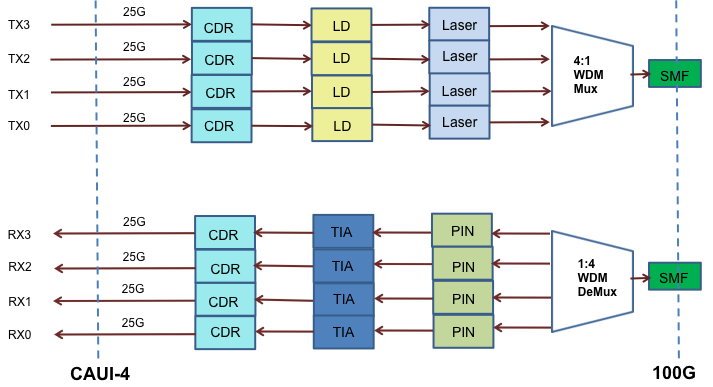
CWDM4 routes four 25G optical transmissions down a single fiber, which is like the qsfp 100g psm4 s. But it has longer reaches of up to 2km on SMF. And CWDM4 uses multiplexer and de-multiplexer to reduce the number of fibers to two rather than eight. When connected into transmission links, on the transmitting side, signals are multiplexed into one channel and transmitted through the SMF; then on the receiving side, the incoming signals are demultiplexed into four separated channels (shown as below).
FAQS About 100GbE QSFP28 Transceivers
Q:Is it possible to insert QSFP+ transceivers to QSFP28 fiber ports for use?
A: No. Different communication protocols were complied for different data rates.
Q:What are the differences between SFP28 and QSFP28 transceivers?
A: They are different on data rate, form factor and working principle.
The transmission data rate of SFP28 transceiver is 25 Gbps, that of QSFP28 is 100 Gbps;
The form factor of SFP28 is SFP, that of QSFP28 is QSFP;
The SFP28 transceiver uses single-channel transmission and has a transmission rate of 25 Gbps;
The QSFP28 transceiver uses four channels of transmission with a transmission rate of 25 Gbps per channel.
|
Transceiver Type |
||
|
Form Factor |
SFP |
QSFP |
|
Data Rate |
25Gbps |
100Gbps |
|
Working Principle |
Single channel |
Quad channel |
Q:Can the QSFP28 transceiver work with CFP transceiver?
A: Yes! Both are products of the Ethernet protocol and can interoperate with each other.
Q:What is the operating temperature range of QSFP28 transceiver?
A: The standard operating temperature range of QSFP28 transceiver commercial version is 0°C to 70°C; that of industrial version is -45°C to +85°C;
Commercial version products are generally applied. There are also some data centers that use products with operating temperatures ranging from 20°C to 50°C to reduce costs.