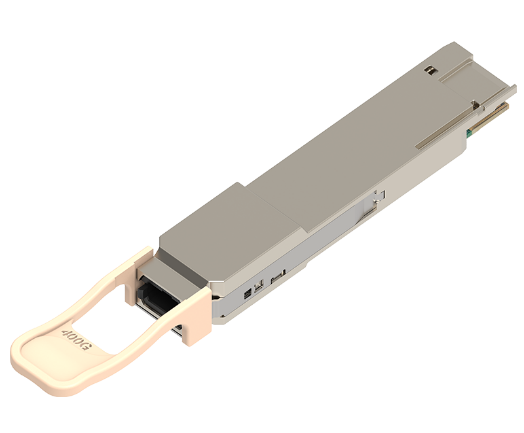



An SFP, Small form-factor pluggable, is a compact and hot-swappable transceiver used to connect a switch or other network device to copper or fiber cable. SFP replaces the formerly common gigabit interface converter (GBIC), and SFP is also called Mini-GBIC. The SFP ports on a switch and SFP modules enable the switch to connect to fiber and Ethernet cables of different types and speeds. The small formfactor pluggable, SFP, specification is based on IEEE802.3 and SFF-8472. Almost all enterprise-class switches include two or more SFP ports, enabling them to become part of a ring- or star-based network topology spread among different buildings, floors or areas, connected via fiber optic cabling.
The SFP+ standard was released in 2006 with a further update in 2011. SFP+ modules support rates up to 16 Gbps. Like the earlier SFP model, they support both fiber and copper, but copper interconnects are limited to 10 meters at 10 Gbps. The SFP+ specification supports single-mode fiber interconnects to 40 km, but some vendors support up to 80 km distances. SFP+ also supports WAN connections based on Optical Transport Network specification OTU2.
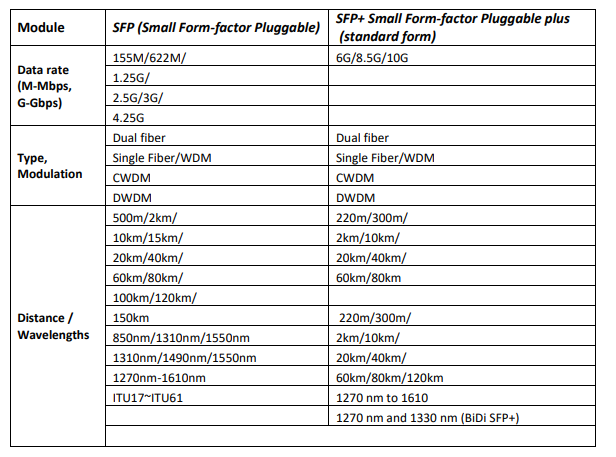
The following is a table of comparison between SFP and SFP+:
10GBASE-T vs. SFP+
By Backward Compatibility
10GBASE-T:
- Backward Compatibility: 10GBASE-T copper cabling is highly backward compatible with standard copper network devices, maximizing the utilization of existing infrastructure.
- RJ45 Connector: Utilizing the familiar RJ45 connector, 10GBASE-T ports can seamlessly connect to 1 gigabit and even 100 megabit interfaces, ensuring compatibility with a wide range of devices.
- Legacy Equipment Connectivity: Direct Attached Cables (DACs) are limited to connecting with 10GbE switches and cannot be used to connect to legacy equipment, posing a limitation in compatibility.
SFP+:
- Flexibility in Transceivers: SFP+ ports offer flexibility in transceiver options, allowing for the insertion of 1 gigabit transceivers that can operate at lower speeds when connected to legacy ports via fiber cable.
- Support for Legacy Ports: SFP modules supporting 1GBase-T can also be inserted into SFP+ ports to connect to legacy ports at slower speeds, providing compatibility with older network infrastructure.
By Power Consumption
10GBASE-T:
- Higher Power Consumption: The 10GBASE-T solution consumes significantly more power compared to SFP+ solutions, typically three to four times more.
- Power Consumption Variability: The power consumption of 10GBASE-T varies depending on the distance of the cable, ranging from 2 to 5 watts per port at each end of the cable.
- Impact in Data Centers: In a typical data center with thousands of cables installed, the higher power consumption of 10GBASE-T can result in increased operational costs and management complexities over time.
SFP+:
- Lower Power Consumption: SFP+ solutions, on the other hand, consume around 0.7 watts per port regardless of the distance of the cable, significantly lower than 10GBASE-T.
- Long-Term Cost Savings: Opting for SFP+ solutions in data centers can lead to substantial cost savings and reduced operational headaches in the long run due to their lower power consumption.
By Latency
10GBASE-T:
- Block Encoding: 10GBASE-T utilizes block encoding to transport data across the cable without errors, adhering to the PHY standard.
- Latency Specification: The standard specifies a latency of 2.6 microseconds for the transmit-receive pair, with the block size requiring latency to be less than 2 microseconds.
SFP+:
- Simplified Electronics: SFP+ employs simplified electronics without encoding, resulting in lower latency compared to 10GBASE-T.
- Typical Latency: The typical latency for SFP+ is around 300 nanoseconds (ns) per link, significantly lower than 10GBASE-T.
While both 10GBASE-T and SFP+ exhibit slight differences in application latency, SFP+ generally offers lower latency compared to 10GBASE-T. High latency can negatively impact CPU performance, thereby limiting data center efficiency and increasing operational costs.
Interface Type: SFP+ vs. RJ45
The main difference between 10G SFP+ and 10GBASE-T lies in the interface type used for transmitting data.
10G SFP+ (Small Form-Factor Pluggable Plus) uses a compact, hot-swappable transceiver module that connects to the network device using fiber optic cables. It is commonly used for short-range and long-range connections, offering high-speed data transmission up to 10 Gigabits per second. SFP+ modules are widely used in data centers and enterprise networks where high bandwidth and low latency are required. They are also known for their low power consumption and low electromagnetic interference.
On the other hand, 10GBASE-T uses RJ45 connectors, similar to the ones used in traditional Ethernet networks. It utilizes twisted-pair copper cables for data transmission, making it compatible with existing infrastructure in many cases. 10GBASE-T is capable of transmitting data at 10 Gigabits per second over distances up to 100 meters. This makes it a convenient choice for network upgrades, as it allows organizations to leverage their existing copper cabling infrastructure without the need for costly fiber optic installations.
One important consideration when comparing these interface types is the power consumption. SFP+ modules generally consume less power than 10GBASE-T, making them more energy-efficient. However, 10GBASE-T has made significant advancements in power efficiency in recent years, narrowing the gap between the two options.
By Transmission Distance
10GBASE-T:
- Limited Distance over Copper: Although 10GBASE-T supports distances up to 100 meters using category 6a or 7 cabling, the transmission distance decreases as the quality of the installed cabling diminishes.
- Extended Reach Challenges: The reach of 10GBASE-T might not suffice for larger facilities or campuses where longer transmission distances are necessary, making fiber alternatives preferable.
SFP+:
- Longer Distance Capabilities: SFP+ supports much greater distances when using optical fiber, with potential reach ranging from several hundred meters to tens of kilometers based on the fiber type and quality.
- Modular Distance Solutions: By selecting different types of optical transceivers, SFP+ can be tailored to fit various distance requirements, providing a high level of versatility for network planning and upgrades.
In summary, the difference between 10G SFP+ and 10GBASE-T lies in the interface type used for data transmission. SFP+ utilizes fiber optic cables and is commonly used in data centers, while 10GBASE-T uses traditional RJ45 connectors and can leverage existing copper cabling infrastructure. The choice between the two depends on factors such as distance requirements, power consumption considerations, and existing network infrastructure.
FAQs About 10G SFP+ Module
Q:How to Choose: 10GB Base-T Switch or SFP+ 10Gbps Switch?
A:The 10G network has become extremely widespread, finding applications not only in data centers and enterprise networks but also in home networking setups. When deciding between two different 10G network solutions, namely the 10GBase-T switch and the 10GB SFP+ switch, it is imperative to consider their contrasting features as key factors in making an informed choice. Therefore, we will explore their differences and provide guidance on how to select the most appropriate option.
Backward Compatibility: 10GB Base-T vs. SFP+ Switches
The 10GBase-T copper cable switch, based on 10GBase-T technology, can automatically negotiate and is backward compatible, allowing it to connect with 1G and 100M devices. In contrast, the 10G fiber optic switch, based on optical fiber technology, does not support connections with lower-speed devices. In other words, if you are upgrading from earlier 1G and 100M networks to a 10G network, the 10GBase-T copper cable switch is a more cost-effective option compared to the 10G fiber optic switch because it only requires upgrading a portion of the servers and switches.
Transmission Distance of These Two 10GbE Switches
The 10GBase-T switch uses mostly copper cables, such as Cat6, Cat6a, Cat7, and similar types, making it suitable for network environments within 100 meters. In contrast, the 10GB SFP+ switch uses fiber optic cables for data transmission, with a maximum transmission distance of up to 100 kilometers (62 miles), far exceeding the capabilities of copper cables. As a result, the 10GB SFP+ switch is well-suited for network deployments that require coverage over longer distances.
Applications Distinction: 10GbE SFP+ vs. 10GBase-T Switches
The 10GbE SFP+ switch is an excellent choice for large-scale, high-speed networking applications because of its remarkable improvements in reducing latency and power consumption. Its ability to support many ports is also beneficial for building dense network configurations. As a result, it is well suited for business-oriented networking needs.
On the other hand, 10GBase-T switches with a limited number of ports (e.g., 8 ports) are well suited for home use, while those with a larger number of ports, such as 48 ports, are more suitable for enterprise-level network deployments.
Cost Analysis of a 10G Ethernet Network
In today’s switch market, switches with similar specifications (such as the same number of ports) in the 10GBASE-T category often cost more than their counterparts in the 10G fiber optic switch category. If both types of 10G switches can meet your requirements, it is advisable to choose the 10G fiber optic switch. This choice will allow you to upgrade to even faster networks in the future.
Q: What is industrial transceiver and how to choose it?
A: “The Definitive Guide to Industrial Transceiver” provides readers with a comprehensive guide to industrial-grade optical modules, including their description, characteristics, advantages, application situations, and purchasing considerations.
Q: What benefits can Walsun 10G SFP+ modules offer?
A: Walsun 10G SFP+ modules offer several benefits:
1. Wide Variety: Walsun provides a wide variety of 10 Gigabit Ethernet connectivity options suitable for data centers, enterprise wiring closets, and service providers.
2. High Flexibility: These modules offer excellent flexibility and scalability options, particularly the 10G CWDM modules. With support for multiple wavelengths, organizations can easily adapt to changing network requirements.
3. Long-Distance Support: Walsun 10G SFP+ modules support various transmission distances. For instance, 10GBASE-T copper cable modules can cover network links of up to 100 meters using Cat6a/Cat7 cables, while SFP+ optical devices can support distances of up to 300 meters.
4. Cost-Effectiveness: Walsun emphasizes cost-effectiveness without compromising performance. SFP+ optical transceivers have the potential to significantly reduce costs while maintaining high performance standards.
These benefits make Walsun 10G SFP+ modules a reliable choice for various networking needs, providing versatility, performance, and cost efficiency.
Q: How about the compatibility of Walsun 10G SFP+ modules?
A: The compatibility of Walsun 10G SFP+ modules is generally high with a wide range of networking equipment. Walsun offers a comprehensive range of SFP+ modules designed to be compatible with various brands such as Cisco, Arista, HPE, Dell, Juniper, and more. These modules undergo rigorous testing to ensure interoperability and performance with different networking devices.
Furthermore, Walsun provides detailed information on compatibility, including lists of compatible devices for each SFP+ module. This allows customers to easily identify which modules are suitable for their specific networking environment.
Q: Can I use a 10G SFP+ module in a 1G SFP port?
A: You can use a 10G SFP+ module in a 1G SFP port, but it will operate at 1G speed. The 10G SFP+ modules are designed for faster speeds, they are usually backward compatible with 1G SFP ports. The 10G SFP+ module needs to be downgraded to 1G speed, which is typically not encouraged for economic reasons. It is critical to check compatibility and ensure adequate functionality for the individual networking devices and modules being used.
While using a 10G SFP+ module in a 1G SFP port is technically feasible, it’s more common and practical to use 1G SFP modules for compatibility and optimal performance.