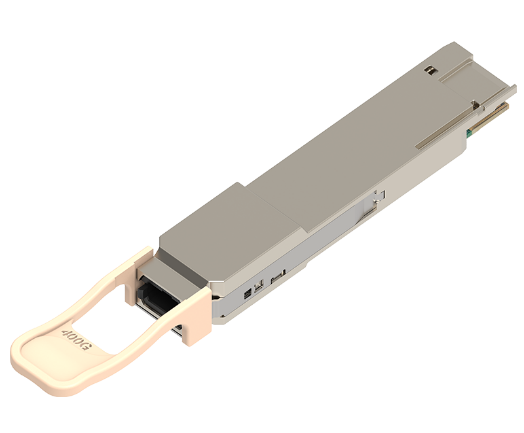



With the huge demand for high bandwidth from 5G, the Internet of Things (IoT), and cloud data centers, attention to 400G Ethernet has been ongoing for several years. Vendors such as Cisco, Arista, and Juniper Networks are developing and testing 400G Ethernet technology. As key hardware devices in interconnected optical networks, 400G transceivers are set to become mainstream in the industry, a fact that is indisputable. This article will provide a comprehensive overview of the different types of 400G transceivers, including their applications, interface standards, and form factors.
Table of Contents
ToggleTransceiver Applications
Based on their applications, optical modules can be divided into two categories: client-side optical modules and line-side optical modules.
400G Ethernet Transceivers for Client-Side Transmission
Client-side transceivers are used for interconnection between metropolitan area networks (MANs) and fiber backbones. Compared to the line side, the term “client-side” refers to relatively short distances, typically ranging from 50 meters to 10 kilometers. Only one transceiver is connected to the fiber, so coherent optics are not required. IEEE and MSA have standardized various transceiver interfaces. Most importantly, they have standardized interfaces for network connections. IEEE802.3bs has chosen PAM4 for 400GE client-side transmission.
400G Coherent Optical Modules for Line-Side Transmission
Unlike the client side, the line side uses DWDM to achieve transmission distances of up to 80 kilometers or more. Coherent technology is expected to enable 400G line-side transmission.
Interface Standards
Transceiver interfaces are defined by interface standards. The table below lists common 400G Ethernet standards and their corresponding interfaces.
Note: No transceiver vendor has released a 400GBASE-SR16 yet. Due to the high number of fibers required for the 400GBASE-SR16 interface (32 fibers per duplex link), it is expected that this standard will not enter the 400G transceiver market.
400G Transceiver Form Factors
- 400G Packaging Mainstreams: Several types of 400G packaging, including 400G QSFP-DD, OSFP, CFP8, and COBO, some of which are already on the market, while others are still in the design phase.
- CFP8: The first generation of 400G optical modules, with relatively large physical dimensions and the lowest port density.
- COBO: Stands for “Consortium for On-Board Optics,” which installs devices internally on-line cards in controlled environments, thus lacking flexibility.
- OSFP: Stands for Octal Small Form Factor Pluggable, a new type of pluggable packaging. Some companies are already selling 400G OSFP optical modules on their websites.
- 400G QSFP-DD: One of the most popular optical modules on the market. Companies such as Finisar, Innolight, and FS.COM have launched and are producing 400G QSFP-DD optical modules.
FAQs
1.What is 400G QSFP-DD optical module?
A:400G optical module refers to the transmission rate of 400Gbps optical module products. At present, the mainstream package types are QSFP-DD and OSFP. Qsfp-dd is a high-speed optical module interface specification, and the upgraded version of QSFP interface supports 400G high-speed transmission. The optical fiber is used as the signal transmission medium, and the electrical signal is converted into optical signal and transmitted in the optical fiber.
2.What are the common types of 400G QSFP-DD optical modules on the market?
A:The common 400G QSFP-DD optical module on the market has the following types: QSFP-DD SR8, QSFP-DD DR4, QSFP-DD FR4, QSFP-DD FR8, QSFP-DD LR4, QSFP-DD LR8, and QSFP-DD ER8 Optical modules.
3.What are the differences between QSFP-DD and OSFP optical modules?
A:QSFP-DD size is smaller, more suitable for data center applications, is the mainstream development direction, OSFP package size is slightly larger, greater power consumption, more suitable for telecommunications applications. In contrast, the QSFP-DD interface provides a four-channel small size and double port density, OSFP of 8 high-speed electrical channels, QSFP-DD good compatibility and perfect support for 400G is still the market choice.
4.What is the transmission distance of 400G QSFP-DD optical module?
A:The transmission distance of a 400G QSFP-DD optical module depends on the type of optical fiber used and the specifications of the optical module. Generally speaking, it can support a transmission distance of 100m-40km.
Summary
In addition to the above classifications of 400G optical modules, common features like fiber mode and wavelength are also used to categorize optical modules, which will not be discussed here. The demand for high-speed data transmission is skyrocketing. As the optical module market evolves, we can expect 400G Ethernet to be deployed in next-generation data centers soon, and 400G optical modules will become widespread. While testing 400G optical modules in the research stage presents both opportunities and challenges, 400G Ethernet remains an inevitable trend.