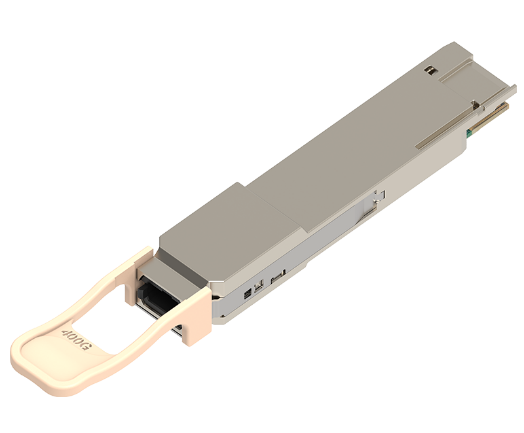



While the current ramp in demand for the components companies may be in 400G optical modules, the 800G optical network application is about to embark on the journey of high-speed, high-density ports and low latency DCI. The 800G transceiver can receive 8 billion bits per second, which is more than twice the amount used by the previous generation (400G optical transceivers). This article will take you through the main 800G module package QSFP-DD and OSFP.
What Is the Development Trend of 800G Transceiver Packaging?
Optical module is the optoelectronic device that realizes photoelectric and photoelectric conversion in optical communication, and is the core part of optical communication industry. The form factors of fiber transceivers have changed from GBIC packaging before to smaller SFP packaging and then to the current 800G QSFP-DD and OSFP packaging. The overall development of 800G transceiver toward higher speed, miniaturization, hot-swappable direction. The main application scenarios include Ethernet, CWDM/DWDM, connectors, Fiber Channel, wired access and wireless access, and the sub-scenarios cover the data communication market and the telecom market.
800G Transceiver Form Factors Advantages
800G QSFP-DD Form Factor:
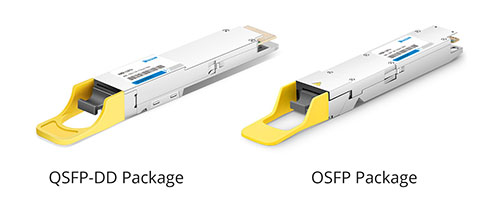
Dual-density four-channel small pluggable high-speed module. QSFP-DD is currently the preferred package for 800G optical modules, enabling data centers to efficiently grow and scale cloud capacity as needed. The QSFP-DD module uses 8-channel electrical interfaces with rates up to 25Gb/s (NRZ modulation) or 50Gb/s (PAM4 modulation) per channel, providing solutions up to 200Gb/s or 400Gb/s aggregation.
The Advantages of 800G QSFP-DD:
1. With backward compatibility, compatible with QSFP+/QSFP28/QSFP56 QSFP package.
2. Adopt 2×1 stacked integrated cage and connector, can support single height and double height cage connector system.
3. With SMT connectors and 1xN cages, cage design and optical module housing optimization enable a heat capacity of at least 12 watts per module. The higher heat capacity can reduce the heat dissipation function requirements of the optical module, thus reducing some unnecessary costs.
4. In the design of QSFP-DD, the MSA working group fully considered the flexibility of user use, adopted the ASIC design, supported a variety of interface rates, and could be backward compatible (compatible with QSFP+/QSFP28), thus reducing port costs and device deployment costs.
800G OSFP Form Factor:
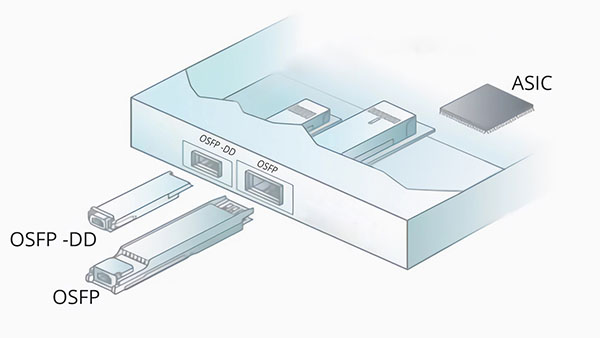
The OSFP is a new type of optical module, much smaller than the CFP8 but slightly larger than the QSFP-DD, with eight high-speed electrical channels that still support 32 OSFP ports on each 1U front panel. With an integrated heat sink, it can greatly improve heat dissipation performance.
The Advantages of 800G OSFP:
1. The OSFP module is designed as an 8-channel (Octal, or 8 lane), directly supporting a total throughput of up to 800G, enabling higher bandwidth density.
2. Because the OSFP package supports more channels and higher data transfer rates, it can provide higher performance and longer transmission distances.
3. OSFP module has excellent thermal design and can handle higher power consumption.
4. OSFP is designed to support higher rates in the future. Due to the larger size of the OSFP module, it has the potential to support higher power consumption and thus higher rates, such as 1.6T or higher.
800G Transceiver Form Factors Parameter Comparison:
|
QSFP-DD
|
OSFP
|
|
|---|---|---|
|
Size(length*width*height)
|
89.4mm*18.35mm*8.5mm
|
107.8mm*22.58mm*13.0mm
|
|
Electrical Lanes
|
8
|
8
|
|
Single Lane Rate
|
25Gbps/50Gbps/100Gbps
|
25Gbps/50Gbps/100Gbps
|
|
Total Max Data Rate
|
200G/400G/800G
|
200G/400G/800G
|
|
Modulation
|
NRZ/PAM4
|
NRZ/PAM4
|
|
Backward Compatibility with QSFP+/QSFP28
|
Yes
|
No
|
|
Port density in 1U
|
36
|
36
|
|
Bandwidth in 1U
|
14.4Tb/s
|
14.4Tb/s
|
|
Power consumption Upper Threshold
|
12W
|
15W
|
|
Products
|
Transceiver Modules; DAC & AOC cables
|
Transceiver Modules; DAC & AOC cables
|
Fiber producers prefer OSFP and QSFP-DD. While the latter is generally preferred in telecommunications applications, the former is considered more suitable for data center environments.
How to Choose 800G Transceiver for Your Data Center?
To choose the right 800G transceiver for your network application, it is essential to carefully evaluate various factors, including transmission distance, fiber type, form factor…
The 800G QSFP-DD module is suitable for high-speed network environments, such as data centers, cloud computing, and large-scale networks, to meet the demand for high bandwidth and large-capacity data transmission.
|
FS P/N
|
Power Consumption
|
Connector
|
Chip
|
Packaging Technology
|
Distance
|
SMF/MMF
|
|---|---|---|---|---|---|---|
|
QDD-SR8-800G
|
≤13W
|
MTP/MPO-16
|
Broadcom 7nm DSP Chip
|
COB (Chip on Board) Packaging
|
50m
|
MMF
|
|
QDD800-PLR8-B1
|
≤18W
|
MTP/MPO-16
|
Broadcom 7nm DSP Chip
|
COB (Chip on Board) Packaging
|
10km
|
SMF
|
|
QDD800-XDR8-B1
|
≤18W
|
MTP/MPO-16
|
Broadcom 7nm DSP Chip
|
COB (Chip on Board) Packaging
|
2km
|
SMF
|
|
QDD-DR8-800G
|
≤18W
|
MTP/MPO-16
|
Broadcom 7nm DSP Chip
|
COB (Chip on Board) Packaging
|
500m
|
SMF
|
The 800G OSFP module is suitable for network environments that require high bandwidth and large capacity data transmission, such as data centers, cloud computing, and ultra-large-scale networks.
|
Type
|
FS P/N
|
Power Consumption
|
Connector
|
Chip
|
Packaging Technology
|
Distance
|
SMF/MMF
|
|---|---|---|---|---|---|---|---|
|
Ethernet
|
OSFP800-2LR4-A2
|
≤18W
|
Dual LC Duplex
|
Broadcom 7nm DSP Chip
|
COB (Chip on Board) Packaging
|
10km
|
SMF
|
|
OSFP800-PLR8-B1
|
≤16.5W
|
MTP/MPO-16
|
Broadcom 7nm DSP Chip
|
COB (Chip on Board) Packaging
|
10km
|
SMF
|
|
|
OSFP800-PLR8-B2
|
≤16.5W
|
Dual MTP/MPO-12
|
Broadcom 7nm DSP Chip
|
COB (Chip on Board) Packaging
|
10km
|
SMF
|
|
|
OSFP-2FR4-800G
|
≤18W
|
Dual LC Duplex
|
Broadcom 7nm DSP Chip
|
COB (Chip on Board) Packaging
|
2km
|
SMF
|
|
|
OSFP800-XDR8-B1
|
≤16.5W
|
MTP/MPO-16
|
Broadcom 7nm DSP Chip
|
COB (Chip on Board) Packaging
|
2km
|
SMF
|
|
|
OSFP800-XDR8-B2
|
≤16.5W
|
Dual MTP/MPO-12
|
Broadcom 7nm DSP Chip
|
COB (Chip on Board) Packaging
|
2km
|
SMF
|
|
|
OSFP800-DR8-B1
|
≤16.5W
|
MTP/MPO-16
|
Broadcom 7nm DSP Chip
|
COB (Chip on Board) Packaging
|
500m
|
SMF
|
|
|
OSFP-DR8-800G
|
≤16W
|
Dual MTP/MPO-12
|
Broadcom 7nm DSP Chip
|
COB (Chip on Board) Packaging
|
500m
|
SMF
|
|
|
InfiniBand
|
OSFP-SR8-800G
|
≤15W
|
Dual MTP/MPO-12
|
Broadcom 7nm DSP Chip
|
COB (Chip on Board) Packaging
|
50m
|
MMF
|
|
OSFP-DR8-800G
|
≤16.5W
|
Dual MTP/MPO-12
|
Broadcom 7nm DSP Chip
|
COB (Chip on Board) Packaging
|
500m
|
SMF
|
|
|
OSFP-2FR4-800G
|
≤16.5W
|
Dual MTP/MPO-12
|
Broadcom 7nm DSP Chip
|
COB (Chip on Board) Packaging
|
2km
|
SMF
|