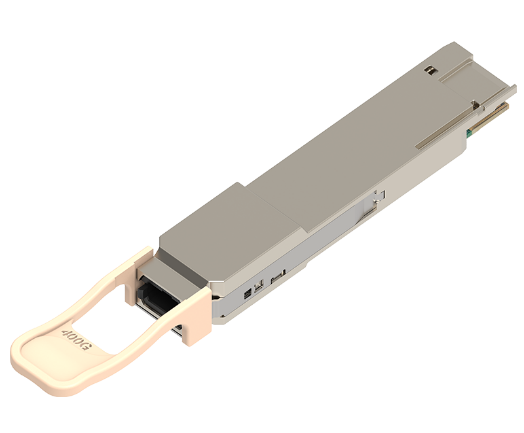



The QSFP-40G Series consists of Quad Small Form Factor Pluggable (QSFP) transceiver modules that are specifically designed for high-performance integrated duplex data link over single mode optical fiber. These transceiver modules are compliant with the QSFP Multi-source Agreement (MSA) and are hot pluggable. These modules offer an easy way to be installed in QSFP MSA compliant ports at any time without the interruption of the host equipment operation.
The QSFP-40G series also supports SFP-DDM (Digital Diagnostic Monitor) function that greatly helps network administrator to easily monitor real-time parameters of the SFP, such as optical output power, optical input power, temperature, laser bias current, and transceiver supply voltage.
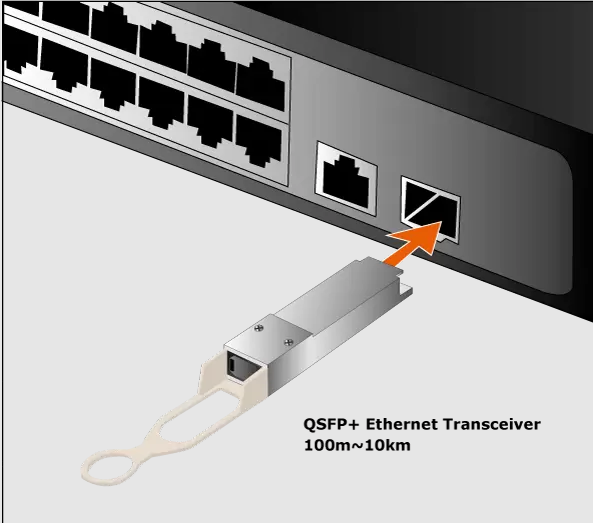
1. Form Factors
QSFP+ (Quad Small Form-Factor Pluggable Plus):
- The most common form factor for 40G transceivers.
- Provides four channels of data at 10Gbps each, aggregating to 40Gbps.
- Offers high-density and low-power solutions for 40G networking.
2. Types of 40G QSFP+ Transceivers
- Description: Designed for short-range multimode fiber (MMF) applications.
- Distance: Up to 100 meters on OM3 MMF and 150 meters on OM4 MMF.
- Wavelength: 850 nm.
- Connector: 12-fiber MPO/MTP.
- Applications: Data center and intra-rack connections.
- Description: Designed for long-range singlemode fiber (SMF) applications.
- Distance: Up to 10 km.
- Wavelength: Uses four wavelengths (1270 nm, 1290 nm, 1310 nm, 1330 nm) multiplexed together.
- Connector: Duplex LC.
- Applications: Campus and long-distance data center connections.
40GBASE-CR4:
- Description: Designed for short-range copper connections.
- Distance: Up to 7 meters using copper Direct Attach Cables (DAC).
- Connector: QSFP+ to QSFP+.
- Applications: Short interconnects within racks or between adjacent racks.
- Description: Extended range singlemode fiber application.
- Distance: Up to 40 km.
- Wavelength: Uses CWDM technology with four channels (1270 nm, 1290 nm, 1310 nm, 1330 nm).
- Connector: Duplex LC.
- Applications: Metro and long-haul networks.
- Description: Short-range single fiber solution.
- Distance: Up to 150 meters on OM4 MMF.
- Wavelength: Uses bidirectional transmission at 850 nm and 900 nm.
- Connector: Duplex LC.
- Applications: Data centers where fiber availability is limited.
3. Additional 40G Transceiver Options
40G QSFP+ AOC (Active Optical Cable):
- Description: Integrates transceivers and optical fiber into a single cable assembly.
- Distance: Typically up to 100 meters.
- Applications: High-density intra-rack and inter-rack connections.
40G QSFP+ DAC (Direct Attach Cable):
- Description: Copper cable with integrated transceivers.
- Distance: Typically up to 7 meters.
- Applications: Cost-effective solution for short-distance connections.
4.Features
- Compliant with 40G Ethernet IEEE802.3ba and 40GBASE-ER4 Standards
- QSFP+ MSA Compliant
- Compliant with QDR/DDR Infiniband data rates
- Up to 11.2Gb/s data rate per wavelength
- 4 CWDM lanes MUX/DEMUS design
- Up to 40 km Transmission on Singlemode Fiber
- 18.5dB link insertion loss budget
- Operating Case Temperature: 0~70°C
- Maximum 3.5W Operation Power
- SMF LC Duplex Connector
- RoHS Compliant
5.Applications
- 40GBASE-ER4 Ethernet Links
- Infiniband QDR and DDR Interconnects
- Client-side 40G Telecom Connections
6. Selecting the Right 40G Transceiver
Determine Distance Needs:
- Choose SR4 for short distances, LR4 for long distances, and ER4 for extended distances.
Consider Fiber Type:
- Match the transceiver to your existing fiber infrastructure (MMF or SMF).
Check Connector Compatibility:
- Ensure the transceiver connectors are compatible with your cabling and networking equipment.
Evaluate Power and Thermal Requirements:
- Ensure your equipment can support the power and cooling needs of the transceivers.
FAQs about FS 40G QSFP+ Transceivers
Q: What is the 40G QSFP+ transceiver max supported distance?
A: The maximum supported distance of a 40G QSFP+ transceiver can vary depending on factors such as the type of fiber optic cable used and the specific model of the transceiver. Generally, for short-range connections over multimode fiber (MMF), the maximum distance is around 150 meters. However, for long-range connections over single-mode fiber (SMF), the distance can extend up to 80 kilometers in Walsun.com. It’s essential to verify the specifications of the particular transceiver model and consult the manufacturer’s datasheet for accurate distance information.
Q: Can the 40G-LR4 transceiver also be split into 4x10G connections?
A: No, the 40G-LR4 transceiver cannot be split into 4x10G connections. This transceiver utilizes 4 lambdas on a pair of single-mode fibers, making it unsuitable for splitting without considerable complexity to separate the wavelengths. Unlike other QSFP+ transceivers that support breakout connectivity, the 40G-LR4 transceiver does not offer this capability. It operates using 4 lambdas to achieve a single 40G connection and does not have the necessary design to be split into multiple 10G connections.
In contrast, the 40GBASE-SR4 utilizes parallel (ribbon) fiber, creating 4 fiber pairs for multiple connections. As an alternative, single-mode parallel 40G optics like the 40G-PLRL4 and 40G-PLR4 are available, supporting splitting into 4x10G connections. These optics are fully compatible with 10GBASE-LR and 10G-LRL up to their maximum distances, utilizing single-mode MTP-12 ribbon for connectivity.
Q: What cable type is needed for the PLRL4 and PLR4 transceivers?
A: The Walsun PLR4 and PLRL4 transceivers require an Angle Polished Connector (APC) single-mode MTP-12 cable for optimal performance. This cable type is specifically designed to accommodate single-mode fiber connections and ensures reliable transmission over long distances. The MTP-12 connector is used to facilitate direct connections, and the APC type minimizes signal loss and reflections, crucial for single-mode fiber applications.
The cable’s configuration is equivalent to the 40G-SR4 MTP to MTP, with the primary distinction being the utilization of single-mode fiber. Unlike UPC connectors, which are unsuitable for single-mode fiber, APC connectors are the preferred choice for ensuring optimal performance in single-mode MTP-12 fiber connections.
Q: How does the QSFP+ to SFP+ fiber convertor allow 4x 10G?
A: To enable 4x 10G connectivity, a QSFP+ to SFP+ fiber converter utilizes a breakout cable. This cable splits the 40G channel provided by the QSFP+ transceiver into four individual 10G channels, each connected to an SFP+ transceiver. Essentially, the converter breaks down the high-speed 40G signal into four separate 10G signals, allowing each SFP+ port to transmit data at 10G speeds. This configuration is beneficial for scenarios where equipment with SFP+ interfaces needs to communicate with a device equipped with a QSFP+ port, providing flexibility and compatibility in networking setups.