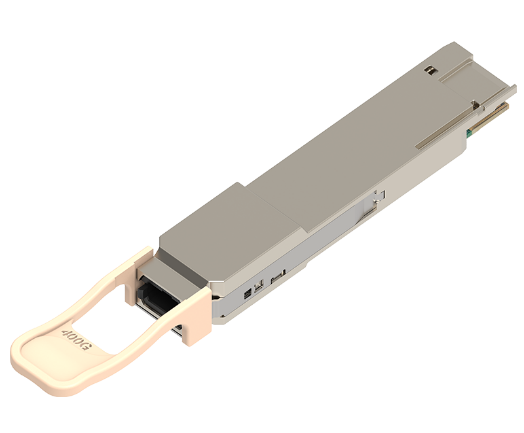



The 400G QSFP-DD (Quad Small Form-factor Pluggable Double Density) optical module is an advanced high-speed transceiver designed to meet the growing demands for increased data transmission rates in data centers and high-performance computing networks. QSFP-DD modules are capable of supporting up to 400 Gbps data rates, doubling the density of traditional QSFP transceivers by adding a second row of electrical contacts. This increased density allows for higher port density and more efficient use of space in networking equipment.
400G QSFP-DD modules typically use wavelengths of 850nm, 1310nm, or 1550nm, depending on the specific application and transmission distance. They come in various types, including 400G SR8, 400G DR4, 400G FR4, 400G LR4, and 400G ZR, each designed to meet specific performance and distance requirements.
What are the types of 400G QSFP-DD optical transceivers?
· 400G SR8 QSFP-DD
The transmission distance of the 400G SR8 module through multimode fiber can be up to 70m on OM3 fiber or 100m on OM4 fiber. The transmission rate is up to 425Gbps and the central wavelength is 850nm. 400G QSFP-DD SR8 optical module is more suitable for short-distance interconnection or multi-channel data communication.

· 400G DR4 QSFP-DD
400G DR4 module achieves the transmission over SMF(single-mode fiber) with an MPO-12 connector. It supports a max transmission distance of 500m on single-mode fiber. In addition, 400G DR4 is also the base form of 400G silicon optical modules. In the 400G era of the data center, 400GBASE DR4 can not only realize the four-in-one Breakout networking, which can be transmitted to 100G DR1/FR1, but also replace the short-range multimode 400G optical module interconnection on the access side, with end-to-end cost competitiveness.
Plus, there’s an exclusive type similar to DR4 which is called the 400G XDR4 QSFP-DD module. The 400GBASE-XDR4 (extended reach DR4) transceiver, up to 2km over parallel SMF. The 400G XDR4 can break out to 4 x 100G, and interop with 4 x 100G-FR QSFPs.
· 400G FR4 QSFP-DD
400G FR4 module supports link lengths of up to 2km SMF with duplex LC connector. This module uses CWDM (wavelength division multiplexing) technology, using 8 channels of 53Gbps PAM4 signals on the electrical side, and 4 channels of 106Gbps PAM4 signals on the optical side, which is twice the rate of the electrical side.
The transmitter unit of the module uses a 4-channel laser driver chip to drive 4 groups of TOSA to realize the electric/optical conversion, and the 4 optical signals with the center wavelengths of 1271nm, 1291nm, 1311nm and 1331nm are outputted after the conversion, and then a MUX couples these four groups of signals into one SMF.
· 400G LR4 QSFP-DD
400GBase LR4 fiber optic modules are designed with a built-in Gearbox chip that multiplex the two channels’ electrical input data into single-channel outputs signal and then modulates it to the optical receiver end. Specifically, the DSP basis gearbox converts 8 channels of 25GBaud PAM4 signals into 4 channels of 50GBaud (PAM4) signals over an SMF (Singlemode Fiber) cable with duplex LC connectors. This 400G QSFP-DD LR4 transceiver product features FEC and full real-time digital diagnostic monitoring, supporting a transmission distance of up to 10km. It defines a 400 Gb/s PHY for operation on the four CWDM center wavelengths of 1271nm, 1291nm, 1311nm, and 1331nm.
Plus, there’s an exclusive type similar to DR4 which is called the 400G PLR4 QSFP-DD module. The 400GBASE-PLR4 (Parallel Long Reach) transceiver, up to 10km over parallel SMF. And the 400G PLR 4 can break out to 4 x 100G, and interop with 4 x 100G-LR QSFPs.
· 400G LR8 QSFP-DD
The 400GBASE-LR8 module supports link lengths of up to 10km over a standard pair of G.652 single-mode fiber (SMF) with duplex LC connectors. It is compliant to IEEE 802.3bs protocol and 400GAUI-8/CEI-56G-VSR-PAM4 standard. The 400 Gigabit Ethernet signal is carried over eight wavelengths. Multiplexing and demultiplexing of the eight wavelengths are managed within the device.
· 400G ER8 QSFP-DD
The 400GBASE-ER8 module supports link lengths of up to 40km over a standard pair of G.652 single-mode fiber (SMF) with duplex LC connectors. It is compliant to IEEE 802.3cn protocol and 400GAUI-8, QSFP-DD HW Rev 5.1, and QSFP-DD CMIS Rev 4.0 standard. The 400 Gigabit Ethernet signal is carried over eight wavelengths: 1273.54nm, 1277.89nm, 1282.26nm, 1286.66nm, 1295.56nm, 1300.05nm, 1304.58nm, 1309.14nm. Multiplexing and demultiplexing of the eight wavelengths are managed within the device.
· 400G ER4 QSFP-DD
Similar to 400G ER8, the 400G ER4 module supports link lengths of up to 40km over a standard pair of G.652 single-mode fiber (SMF) with duplex LC connectors. But, the 400G ER4 QSFP-DD has only four wavelengths which are The central wavelengths of the 4 LAN WDM channels are 1295.56nm, 1300.05nm, 1304.58nm and 1309.14nm.
QSFP-DD vs OSFP vs QSFP+/QSFP28/QSFP56
1) QSFP-DD vs OSFP
The QSFP-DD module is defined by the QSFP-DD MSA, while the OSFP module is defined by the OSFP MSA. The OSFP is slightly wider and longer than the QSFP-DD, and therefore takes up more PCB surface area of the switch. OSFP module can arrange 32 ports on each 1U panel of the switch, while QSFP-DD can arrange 36 ports.
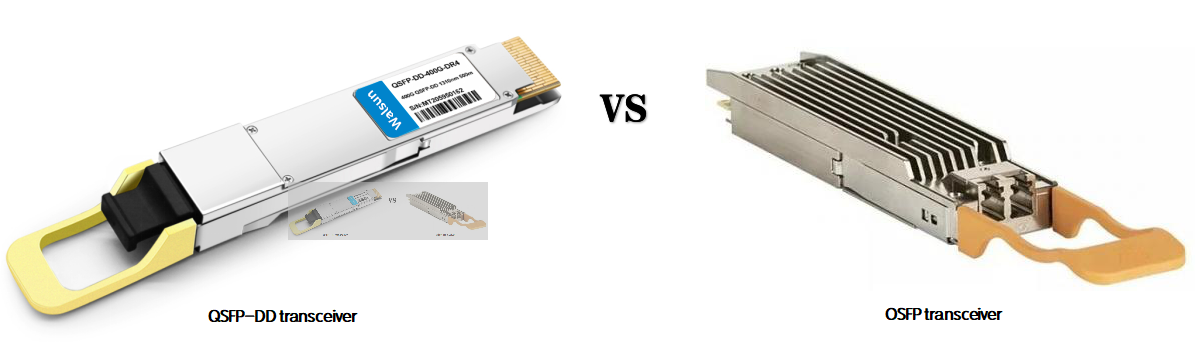
Therefore, in terms of switch bandwidth capacity, QSFP-DD can provide 4 more ports. Moreover, QSFP-DD has backward compatibility with QSFP and QSFP28. From these two points of view, the future of the QSFP-DD transceiver module seems brighter.
2) QSFP-DD vs QSFP vs QSFP28 vs QSFP56
Although QSFP-DD and QSFP+/QSFP28/QSFP56 belong to the same QSFP package and have the same size, there are still some differences between them.
· Structure
The QSFP-DD module is equipped with an 8-channel electrical interface. Compared with QSFP+/QSFP28/QSFP56 which has only a 4-channel electrical interface, the number of electrical interface channels of QSFP-DD is doubled, which is also due to a row of additional conductive metal.
· Bandwidth&Application
QSFP-DD is generally used as the form factor of 400G transceiver and 400G high-speed cables (i.e. DAC and AOC), which is used for the interconnection of 400G data centers to solve the problem of mass data migration between data centers; while QSFP+/QSFP28 /QSFP56 are respectively used for the 40G/100G/200G optical modules and high-speed cables, and for 40G/100G/200G network interconnection.
· Compatibility
Because QSFP-DD is backward compatible, modules or connectors in QSFP+/QSFP28/QSFP56 form factors can be plugged into QSFP-DD ports. In contrast, modules or connectors in the QSFP-DD form factors cannot be plugged into QSFP+/QSFP28/QSFP56 ports.
Product Applications
400G QSFP-DD optical modules are designed for use in high-performance networking environments where high bandwidth and port density are critical. Key applications include:
- Data Centers: Enabling high-speed connectivity between servers, switches, and storage devices, supporting large-scale data processing and cloud services.
- Telecommunications: Providing high-capacity backbone connections and supporting next-generation metro and long-haul network deployments.
- High-Performance Computing (HPC): Facilitating fast data exchange in supercomputing environments and research facilities.
- Enterprise Networks: Upgrading core and aggregation layers to handle increased data traffic and higher bandwidth requirements.
Conclusion
From automated industrial production to vehicle networking, from enterprise networks to carriers, 400G optical communication already points to two application scenarios: one is a cloud computing center, and the other is a high-speed transmission link. To realize these application scenarios, mature technical support is required. Walsun can provide you with 400G QSFP-DD full series optical modules, and ensure the stability of quality and supply.
FAQs About 400G Transceivers
Q、What form-factors are used for 400G optics and cables?
A、There are two form-factors defined for 400G optical modules and cables:
• The OSFP: The OSFP stands for “Octal Small Form-factor Pluggable”. It is described as an “Octal” module because the electrical interface of an OSFP connector consists of 8 electrical lanes, running at 50Gb/s each, for a total of bandwidth of 400Gb/s.
• The QSFP-DD: The QSFP-DD stands for “Quad Small Form-factor Pluggable (QSFP) – Double Density (DD)”. The electrical interface of a QSFP-DD connector also has 8 electrical lanes, running at 50Gb/s each, for a total bandwidth of 400Gb/s. The QSFP-DD form factor is similar to the QSFP form factor, except a second row of electrical contacts has been added to increase the number of high-speed electrical lanes from 4 (in a QSFP) to 8 (in a QSFP-DD).
Q、What 400 form-factors does Walsun support?
A、Walsun supports both OSFP and QSFP-DD form-factors – i.e. Walsun 400G platforms will be offered in both OSFP and QSFP-DD variants (a detailed comparison of OSFP and QSFP-DD form factors is contained later in this document).
Q、Can I plug an OSFP module into a QSFP-DD port, or a QSFP-DD module into an OSFP port?
A、No. The OSFP and the QSFP-DD are two physically distinct form factors. If you have an OSFP system, then OSFP optics and cables must be used. If you have a QSFP-DD system, then QSFP-DD optics and cables must be used.
Q、Can I have an OSFP on one end of a 400G link, and a QSFP-DD on the other end?
A、Yes. The OSFP and QSFP-DD describe the physical form factor of the module. As long as the Ethernet media types are the same (i.e. both ends of the link are 400G-DR4, or 400G-FR4 etc.), OSFP and QSFP-DD modules will interop with each other.
Q、Can I plug a 100G QSFP module into a QSFP-DD port?
A、Yes. A QSFP (40G or 100G) module can also be inserted into a QSFP-DD port (without a mechanical adapter). When using a QSFP module in an QSFP-DD port, the QSFP-DD port must be configured for a data rate of 100G (or 40G), instead of 400G.
Q、What do the suffixes “SR8, SR8-C, SRBD, VSR4, DR4 / XDR4 / PLR4, FR4 / LR4 and 2FR4” stand for?
A、In general, the letters refer to reach or optics technology, and the number refers to the number of optical channels:
i) SR8: “SR” refers to 100m reach using multi-mode fiber, and “8” implies there are 8 optical channels. Each of the 8 optical channels from an SR8 module are carried on separate fibers, resulting in a total of 16 fibers (8 Tx and 8 Rx). Each optical channel operates at 50Gb/s. The SR8 module uses an MPO-16 APC connector to connect to 8 fiber pairs. The SR8 module can be configured for 400GSR8, 2x 200G-SR4 and (operating at ½ rate) 2x 100G-SR4.
ii) SR8-C: Walsun’s 400G-SR8-C transceivers include all the functionality of the 400G-SR8 transceiver, plus the ability to be configured as 8x 50G-SR or 8x25G-SR (“Channelized” configuration)
iii) SRBD: “SR” refers to 100m reach using multimode fiber, and “BD” refers to Bi-directional (BIDI) optical technology. 400G-SRBD transceivers are also referred to as “400G-BIDI” or “400G-SR4.2” transceivers. Walsun’s 400G-SRBD transceivers are compliant with IEEE 400GBASE-SR4.2 and are software configurable to breakout into either 4x 100G-BIDI (QSFP-100G-SRBD) or 4x 100G-SR1.2 links. Refer to later sections in this document for more information on the 400G-SRBD.
iv) VSR4: “VSR” refers to 50m reach using multimode fiber, and the “4” implies there are 4 optical channels. Each of the 4 optical channels are carried on separate fibers, resulting in a total of 4 pairs of fibers. Each optical channel operates at 100Gb/s. There are two IEEE defined standards for 100G/wave MMF optics: 400GBASE-SR4 (for 100m reach over parallel OM4 MMF), and 400GBASE-VR4 (for 50m reach over parallel OM4 MMF). Walsun’s 400G-VSR4 transceivers are fully compliant with the 400GBASE-VR4 standard, and optically interoperable with both 400GBASE-SR4 and 400GBASE-VR4 transceivers over a reach of 50m.
v) DR4, XDR4 and PLR4: “DR” / “XDR” / “LR” refer to 500m / 2km / 10km reach using single-mode fiber, and “4” implies there are 4 optical channels. Each of the 4 optical channels are carried on separate fibers, resulting in a total of 4 pairs of fibers. Each optical channel operates at 100Gb/s. The DR4 / XDR4 / PLR4 modules use the widely deployed MPO-12 APC SMF connector to connect to 4 fiber pairs. vi) FR4 / LR4: “FR” / “LR” refers to 2km / 10km reach using single-mode fiber, and “4” implies there are 4 optical channels. Unlike the DR4 and SR8, all 4 optical channels from an FR4 / LR4 are multiplexed onto one fiber, resulting in a total of 2 fibers from the module (1 Tx and 1 Rx). Each optical channel operates at 100Gb/s. The modules use a duplex LC optical connector.
vii) 2FR4: The “2FR4” refers to 2 x 200G-FR4 links, and has a reach of 2km using single-mode fiber. Each of the 200G FR4 links has 4 optical channels, multiplexed onto one fiber pair (1 Tx and 1 Rx per 200G link). A 400G-2FR4 module has 2 of these links, resulting in a total of two pairs of single mode fiber (or 4 fibers total), and a total of 8 optical channels. Each optical channel operates at 50Gb/s. The 2FR4 module uses a dual CS connector to connect to 2 fiber pairs.