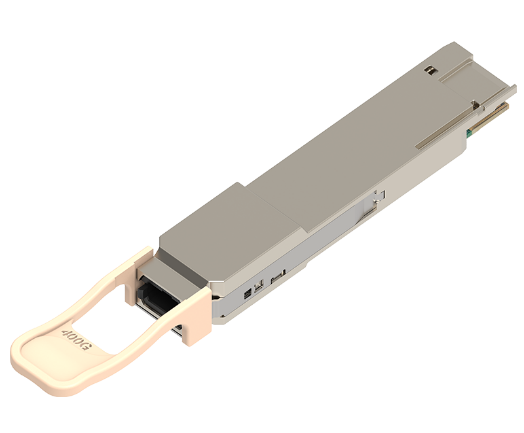



What is 400G QSFP-DD optical transceiver?
The QSFP-DD (Quad Small Form-factor Pluggable Double Density) is forward and backward compatible with the QSFP port and is also compatible with the existing QSFP28 optical modules and AOC/DAC, etc. With NRZ modulation technology, the data rate can be achieved for 200G( 25Gx8 channels) network transmission. Meanwhile, with PAM4 modulation technology, the data rate can reach 400G( 50Gx4 channels) network transmission for high-performance computing data centers and cloud networks. As the best option for the 400GE optical transceiver form factor, this QSFP-DD connector enables data centers to effectively grow and expand cloud capacity as needed.
400G QSFP-DD vs 400G OSFP/CFP8: What are the differences?
A: The table below includes detailed comparisons for the three main form factors of 400G transceivers.
| 400G Transceiver | 400G QSFP-DD | 400G OSFP | CFP8 |
|---|---|---|---|
| Application Scenario | Data center | Data center & telecom | Telecom |
| Size | 18.35mm× 89.4mm× 8.5mm | 22.58mm× 107.8mm× 13mm | 40mm× 102mm× 9.5mm |
| Max Power Consumption | 12W | 15W | 24W |
| Backward Compatibility with QSFP28 | Yes | Through adapter | No |
| Electrical signaling (Gbps) | 8× 50G | ||
| Switch Port Density (1RU) | 36 | 36 | 16 |
| Media Type | MMF & SMF | ||
| Hot Pluggable | Yes | ||
| Thermal Management | Indirect | Direct | Indirect |
| Support 800G | No | Yes | No |
Arista Networks QDD-400G-DR4 Compatible 400G QSFP-DD DR4 PAM4 Optical Transceiver Module (1310nm MTP/MPO SMF 500m with FEC DDM)
Arista QDD-400G-DR4 Compatible 400G DR4 QSFP-DD Transceiver incorporates 4 parallel channels on 1310nm center wavelength, operating at 100G per channel. The Transceiver complies with QSFP-DD MSA, IEEE 802.3bs protocol, and 400GAUI-8 standard. 400 Gigabit Ethernet signals are transmitted over four parallel channels on one wavelength per channel. It can also be connected to 100G DR optical modules. It adopts a 1310nm EML transmitter type and PAM4 pulse amplitude modulation mode. It is used in data centers, high-performance computing networks, enterprise core, and distribution layers, and service provider applications.
Product Details
| Arista Compatible | QDD-400G-DR4 | Vendor Name | Walsun |
| Form Factor | QSFP-DD | Max Data Rate | 425Gbps |
| Wavelength | 1310nm | Max Distance | 500m |
| Modulation Format | PAM4 | Host Required | FEC |
| Connector | MTP/MPO-12 | Voltage Supply | 3.3V |
| Cable Type | SMF | DDM Support | Yes |
| Transmitter Type | 1310nm EML | Receiver Type | PIN |
| TX Power | -2.9~+4.0dBm | Receiver Sensitivity | < -5.9dBm |
| Operation Temperature | 0 to 70°C (32 to 158°F) | Maximum Power | < 10.5W |
| Protocols | QSFP-DD MSA, IEEE 802.3bs 400GBASE-DR4 |
Application | 400G Ethernet, Data Center Interconnect, Infiniband Interconnects |
400G OSFP Transceiver Types
Below lists some current main 400G OSFP transceiver types: OSFP SR8, OSFP DR4, OSFP DR4+, OSFP LR8, OSFP FR4, OSFP 2*FR4, and OSFP LR4, which summarize OSFP transceiver according to the two transmission types (over multimode fiber and single-mode fiber) they support.
| Transmission Type | OSFP Product Description | Reach | Optical Connector | Wavelength | Optical Modulation | Protocol |
|---|---|---|---|---|---|---|
| Multimode fiber | 400G OSFP SR8 | up to 100m?over parallel MMF | MTP-16/MPO-16 | 850nm | 50G PAM4 | IEEE P802.3cm;IEEE 802.3cd |
| Single-mode fiber | 400G OSFP DR4 | up to 500m over parallel SMF | MTP-12/MPO-12 | 1310nm | 100G PAM4 | IEEE 802.3bs |
| 400G OSFP XDR4/DR4+ | up to 2km over parallel SMF | MTP-12/MPO-12 | 1310nm | 100G PAM4 | / | |
| 400G OSFP FR4 | up to 2km over duplex SMF | LC | CWDM4 wavelength | 100G PAM4 | 100Glambda MSA | |
| 400G OSFP 2FR4 | up to 2km over duplex SMF | CS | CWDM4 wavelength | 50G PAM4 | IEEE 802.3bs | |
| 400G OSFP LR4 | up to 10km over duplex SMF | LC | CWDM4 wavelength | 100G PAM4 | 100Glambda MSA | |
| 400G OSFP LR8 | up to 10km over duplex SMF | LC | 1310nm | 50G PAM4 | OSFP MSA, CMIS Rev 4.0, IEEE 802.3bs |
Fibers Connections for 400G OSFP Transceivers
400G OSFP SR8
- Connect a 400G OSFP SR8 transceiver with another 400G OSFP SR8 transceiver over an MTP-16/MPO-16 cable.

- 400G OSFP SR8 to 2× 200G SR4 over MTP-16 to 2× MPO-8 breakout cable.
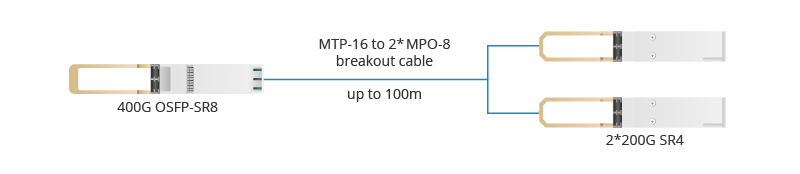
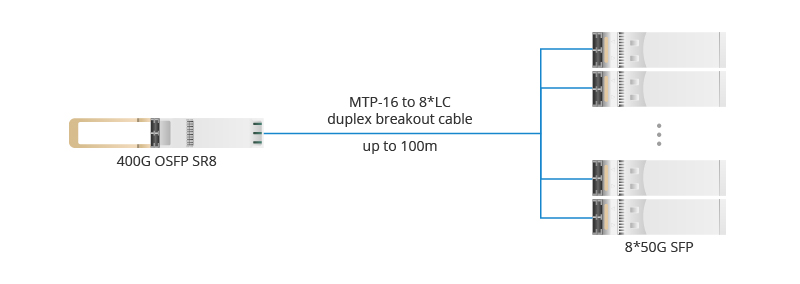
- 400G OSFP SR8 to 8× 50G SFP via MTP-16 to 8× LC duplex breakout cable with up to 100m.
400G OSFP DR4
- 400G OSFP DR4 to 400G OSFP DR4 over an MTP-12/MPO-12 cable.

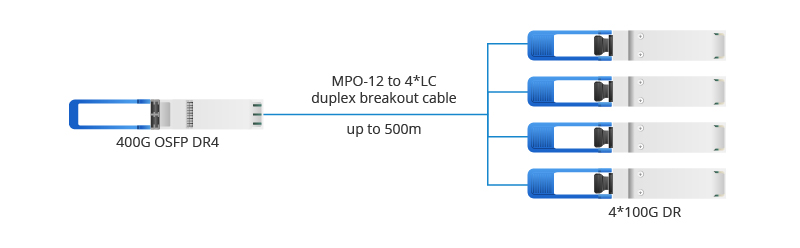
- 400G OSFP DR4 to 4× 100G DR4 over MTP-12/MPO-12 to 4× LC duplex breakout cable.
400G OSFP XDR4/DR4+
- 400G OSFP DR4+ to 400G OSFP DR4+ over an MTP-12/MPO-12 cable.

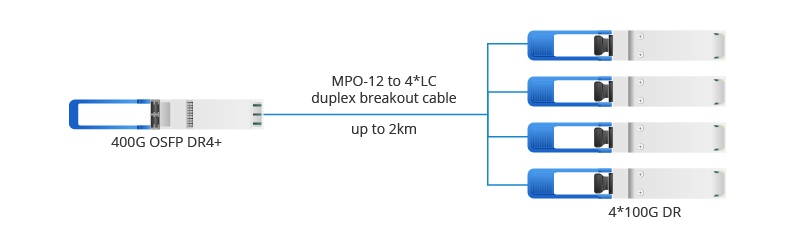
- 400G OSFP DR4+ to 4× 100G DR over MTP-12/MPO-12 to 4× LC duplex breakout cable.
400G OSFP FR4
400G OSFP FR4 to 400G OSFP FR4 over duplex LC cable.

400G OSFP 2FR4
OSFP 2FR4 can break out to 2× 200G and interop with 2× 200G-FR4 QSFP transceivers via 2× CS to 2× LC duplex cable.

400G OSFP LR8
400G OSFP LR8 to 400G OSFP LR8 over duplex LC cable.

Frequently Asked Questions about 400G transceivers
Q: What does it mean when an electrical or optical channel is PAM4 or NRZ in 400G transceivers?
A: NRZ is a modulation technique that has two voltage levels to represent logic 0 and logic 1. PAM4 uses four voltage levels to represent four combinations of two bits logic-11, 10, 01, and 00. The PAM4 signal can transmit double faster than the traditional NRZ signal.
When a signal is referred to as “25G NRZ”, it means the signal is carrying data at 25 Gbps with NRZ modulation. When a signal is referred to as “50G PAM4”, or “100G PAM4”, it means the signal is carrying data at 50 Gbps, or 100 Gbps, respectively, using PAM4 modulation. The electrical connector interface of 400G transceivers is always 8x 50Gb/s PAM4 (for a total of 400Gb/s).
Q: What are the 400G transceivers packaging forms?
A: There are mainly the following six packaging forms of the 400g optical transceiver:
-
- QSFP-DD: 400G QSFP-DD (Quad Small Form Factor Pluggable-Double Density) is an expansion of QSFP, adding one row to the original 4-channel interface to 8 channels, running at 50Gb/s each, for a total bandwidth of 400Gb/s.
-
- OSFP: OSFP (Octal Small Formfactor Pluggable, Octal means 8) is a new interface standard and is not compatible with the existing photoelectric interface. The size of 400G OSFP modules is slightly larger than that of 400G QSFP-DD transceivers.
-
- CFP8: CFP8 is an expansion of CFP4, with 8 channels and a correspondingly larger size.
-
- COBO: COBO (Consortium for On-Board Optics) means that all optical components are placed on the PCB. COBO has good heat dissipation and small-size. However, since it is not hot-swappable, once a module fails, it will be troublesome to repair.
-
- CWDM8: CWDM 8 is an extension of CWDM4 with four new center wavelengths (1351/1371/1391/1411 nm). The wavelength range becomes wider and the number of lasers is doubled.
- CDFP: CDFP was born earlier, and there are three editions of the specification. CD stands for 400 (Roman numerals). With 16 channels, the size of CDFP is relatively large.
Q: Can I plug an OSFP module into a 400G QSFP-DD port, or a QSFP-DD module into an OSFP port?
A: No. OSFP and QSFP-DD are two physically distinct form factors. If you have an OSFP system, then 400G OSFP optics must be used. If you have a QSFP-DD system, then 400G QSFP-DD optics must be used.
Q: Can a QSFP module be plugged into a 400G QSFP-DD port?
A: Yes. A QSFP (40G or 100G) module can be inserted into a QSFP-DD port as QSFP-DD is backward compatible with QSFP modules. When using a QSFP module in a 400G QSFP-DD port, the QSFP-DD port must be configured for a data rate of 100G (or 40G).
Q: Is it possible with a 400G OSFP on one end of a 400G link, and a 400G QSFP-DD on the other end?
A: Yes. OSFP and QSFP-DD describe the physical form factors of the modules. As long as the Ethernet media types are the same (i.e. both ends of the link are 400G-DR4, or 400G-FR4 etc.), 400G OSFP and 400G QSFP-DD modules will interoperate with each other.
Q: What quality certifications do you have for your 400G transceivers?
A: Walsun 400G transceivers accord with a range of certifications for optical transceivers including ISO 9001:2015, RoHS, REACH, CB, RCM, FCC, and Russian TR CU certificate (EAC Certificate). Rest assured that our products will meet essential quality and safety requirements.
Q: Are Walsun 400G transceivers compatible with Cisco or Juniper brands?
A: Many of our 400G transceiver modules are compatible with Cisco, Juniper, Arista, Dell, Mellanox, etc. You can always ask for a compatibility test before the purchase to check whether our transceiver is compatible with your devices. If you’re deploying a larger network or upgrading your current data center architecture, compatible transceiver modules may come in handy as they can be immediately installed without compatibility problems and fit right into your data center infrastructure.
Q: Can I plug Walsun OSFP module into a 400G QSFP-DD port, or Walsun QSFP-DD module into an OSFP port?
A: No. OSFP and QSFP-DD are two physically distinct form factors. If you have an OSFP system, then Walsun 400G OSFP modules must be used. If you have a QSFP-DD system, then Walsun 400G QSFP-DD modules must be used.
Q: Can Walsun 100G QSFP module be plugged into a 400G QSFP-DD port?
A: Yes. A QSFP (40G or 100G) module can also be inserted into a QSFP-DD port (without a mechanical adapter). When using a QSFP module in an QSFP-DD port, the QSFP-DD port must be configured for a data rate of 100G (or 40G), instead of 400G.