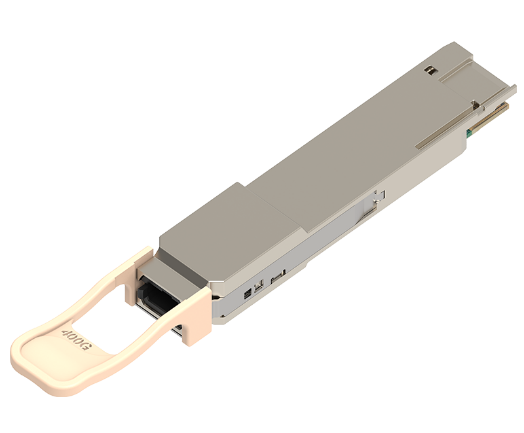



As the demand for higher bandwidth and faster data transmission speeds continues to grow, the development of optical transceivers has evolved significantly. Among the latest advancements in this field is the 200G QSFP56 transceiver, a cutting-edge solution designed to meet the rigorous requirements of modern data centers and high-performance computing networks.
Table of Contents
ToggleWhat is a 200G QSFP56 Transceiver?
The 200G QSFP56 optical module is an upgraded version of the 40G QSFP+ and 100G QSFP28 optical modules, which are specifically designed for 200G Ethernet interconnection. Generally, two 200G QSFP56 optical modules are inserted into the corresponding switch ports and connected with a single-mode or multimode fiber to achieve 200G transmission rate. 200G QSFP56 utilizes a mainstream digital signal processor (DSP) and uses a hot-pluggable QSFP56 package with four independent transmit and receive optical signal channels, each with a transmission rate of 53G.
Depending on the transmission distance, 200G QSFP56 optical modules can be classified into the following five categories:
Walsun can currently offer two types of optical modules, QSFP56 SR4 and QSFP56 FR4:
| Type | Wavelength | Transmission Distance | Interface | Power Consumption |
|---|---|---|---|---|
| QSFP56 SR4 | 850nm | 70/100m | MPO | <5W |
| QSFP56 FR4 | CWDM4 | 2km | Duplex LC | <5W |
| QSFP56 DR4 | 1310nm | 500m | MPO | <5.5W |
| QSFP56 LR4 | LWDM4 | 10/20km | Duplex LC | <7.5W |
| QSFP56 ER4 | LWDM4 | 40km | Duplex LC | <9W |
· QSFP56 200G SR4
The 200G SR4 full-duplex optical module offers 4 independent transmit and receive channels, each capable of 53.125Gb/s operation for an aggregate data rate of 200Gb/s on 70 meters of OM3 multi-mode fiber. An optical fiber cable with an MTP/MPO-12 APC connector can be plugged into the QSFP56 SR4 module receptacle. The central wavelengths of all 4 parallel lanes are 850nm. It contains an optical MPO-12 APC connector for the optical interface and a 38-pin connector for the electrical interface.
· QSFP56 200G FR4
The 200G FR4 module converts the 4-channel 200Gb/s(PAM4) electrical input data into CWDM optical signals (light), by a driven 4-wavelength EMLs. The central wavelengths of the 4 CWDM channels are 1271, 1291, 1311 and 1331 nm as members of the CWDM wavelength grid defined in ITU-T G.694.2. It contains a duplex LC connector for the optical interface and a 38-pin connector for the electrical interface. It is designed for 2km optical communication applications.
200G QSFP56 vs QSFP-DD
There are two technical directions for 200G optical modules, one is a 4x50G PAM4 network in the QSFP56 package type; the other is an 8x25G NRZ network in the QSFP-DD package.
First, as an evolution of the 40G QSFP+ and 100G QSFP28, the QSFP56 (Quad 50 Gigabits Small Form-factor Pluggable) is designed specifically for 200G Ethernet. QSFP56 denotes 4 x 50 to 56Gb/s in a QSFP form factor. Compared with QSFP+ and QSFP28, the QSFP56 form factor as a 200G QSFP supporting 4 x 50G channels can achieve higher network speeds. The most important change from QSFP+ and QSFP28 to QSFP56 is that QSFP56 changes from NRZ encoding to PAM4 encoding. Then, compare to the QSFP56 packaging type, the QSFP-DD (Quad Small Form Factor Pluggable Double-density) optical transceiver is compliant with IEEE802.3bs and QSFP-DD MSA standards. “Double-density” means that the module supports double the number of high-speed electrical interfaces compared to the standard QSFP28 module. In a nutshell, when it comes to QSFP56 vs QSFP-DD, the QSFP-DD modules can support 400Gbps, while QSFP56 can only reach 200Gbps.
200G QSFP56: a new trend
Obviously, the 200G and even 400G transceivers are the new trend in the optical communication market today. On December 6, 2017, IEEE 802 finally approved the IEEE 802.3bs 400G Ethernet standard specification, containing both 400G and 200G Ethernet single-mode. IEEE 802.3cd defines the standard for 200G Ethernet multi-mode, which was officially released in December 2018.
Currently, the 200G QSFP56 SR4 and FR4 transceivers are available in the market from only a few suppliers. Walsun can provide you 200G transceivers that with sufficient supply and excellent quality in the industry.
Applications of 200G QSFP56 Transceivers
Data Centers
Data centers are the backbone of today’s digital economy, supporting cloud computing, big data analytics, and a wide range of online services. The 200G QSFP56 transceiver is well-suited for data center interconnects, enabling high-speed communication between servers, storage systems, and networking equipment. Its high bandwidth and low latency are essential for maintaining the performance and scalability of data center infrastructures.
High-Performance Computing (HPC)
In high-performance computing environments, where vast amounts of data are processed in parallel, the need for high-speed, low-latency connectivity is paramount. The 200G QSFP56 transceiver provides the necessary bandwidth to support HPC workloads, facilitating faster data transfer between computing nodes and storage systems.
Telecommunications
The telecommunications industry relies on robust and high-capacity networking solutions to handle the ever-increasing volume of data traffic. The 200G QSFP56 transceiver is an ideal choice for metro and long-haul networks, offering high data rates and reliability over extended distances.
Summary:
Walsun’s 200G QSFP56 transceivers offer a cutting-edge solution for high-speed data transfer across various network configurations. With features such as advanced modulation, superior signal integrity, and low power consumption, these transceivers are designed to meet the demands of modern data centers, enterprise networks, and high-performance computing environments. Click to discover how Walsun’s 200G QSFP56 transceivers can optimize your network’s performance and reliability!