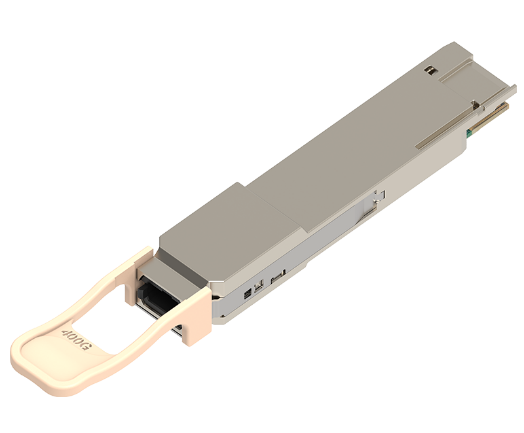



The maximum power consumption of 100G QSFP transceivers depends on the type and vendor of the transceiver. The table below summarizes the power consumption of Arista 100G QSFP transceivers.

* The QSFP-100G-ZR4 is supported on specific platforms because of the higher power draw.
QSFP28 100G Module Standards
The 100G QSFP28 optical module standards are mainly defined by two key organizations, namely IEEE and Multi-Source Agreement (MSA). The QSFP28 SR4, QSFP28 LR4, QSFP28 ER4 are defined by the IEEE. How to clarify these three items from their names? The ‘QSFP’ means the form factor; ‘28’ represents that each lane has a maximum transmission rate of 28Gbps; ‘SR’ means short reach (100m), ‘LR’ is long reach (10km) and ‘ER’ is extended reach (40km). ‘4’ represents that the module has 4 lanes. For example, the QSFP28 LR4 means that it is a long-reach 100G module that can transmit 100G signals over four wavelengths with a transmission distance of 10km.
100GBASE-SR4 and 100GBASE-LR4 are the most commonly used 100G interface specifications defined by the IEEE. However, the transmission distance of QSFP28 SR4 is too short to meet all interconnection requirements and the cost of QSFP28 LR4 is too high for large data centers. Therefore, MSA brought a solution for mid-range connectivity to the market and defined the standards of QSFP28 PSM4 and CWDM4. Although the capability of QSFP 100G LR4 completely covers QSFP28 CWDM4, but the QSFP 100G CWDM4 solution is much cheaper and more competitive than QSFP28 LR4 in the scenario of 2km transmission.
QSFP 100G Laser Types
The laser plays an important role in the 100G QSFP28 optical transceivers which have five major types: VCSEL, FP, DFB, DML, and EML. Different types of lasers have different working wavelengths, modes and application environments.
| Laser Type | Wavelength | Working Mode | Application Scenario |
|---|---|---|---|
| VSCEL | 850nm | Surface Emitting | Within 200m |
| FP | 1310nm/1550nm | Edge Emitting | 500m-10km |
| DFB | 1310nm/1550nm | Edge Emitting | 40km |
| DML | 1310nm/1550nm | Direct Modulated | 500m-10km |
| EML | 1310nm/1550nm | Electro-absorption Modulated | 40km |
- The VCSEL laser features a small size, low power consumption, easy integration, low price, and high coupling efficiency with multimode fibers, which is often used for QSFP28 SR4 modules.
- The EML, with its small dispersion, large extinction and long-distance transmission, is designed to meet all those requirements for QSFP 100G LR4 and QSFP 100G ER4 transceivers.
- The DML can realize signal modulation through the way of modulating the injection current of the laser. Thus, it is suitable for QSFP28 PSM4 and QSFP28 CWDM4 modules with a transmission distance of 500m or 2km.
How to Select the Best 100G QSFP28 Optics?
Now that we know we have to choose the best 100G optics based on our actual demand, but how? How can we choose the right one? Here is a selection guide for you.
For transmission distances between 5m and 100m, you can choose the QSFP28 SR4 optical transceiver module. It can transmit 70m using OM3 fibers or 100m using OM4 fibers.
For transmission distances between 100m to 2km, QSFP 100G PSM4 or QSFP28 CWDM4 modules would be better. The cost of QSFP28 CWDM4 is much higher than the QSFP28 PSM4. However, the QSFP28 CWDM4 requires only two single mode fibers in two-way transmission which is much less than the eight single mode fibers of QSFP28 PSM4, and the total cost of the QSFP 100G PSM4 rises very quickly. In practical applications, it is necessary to decide whether to use QSFP28 PSM4 or QSFP28 CWDM4 depending on the interconnection distance.
For transmission distance between 10km to 40km, you can consider QSFP 100G LR4 which has a maximum transmission distance of up to 10 km, or QSFP28 ER4 transceivers which can reach up to a maximum transmission distance of even further—40km.